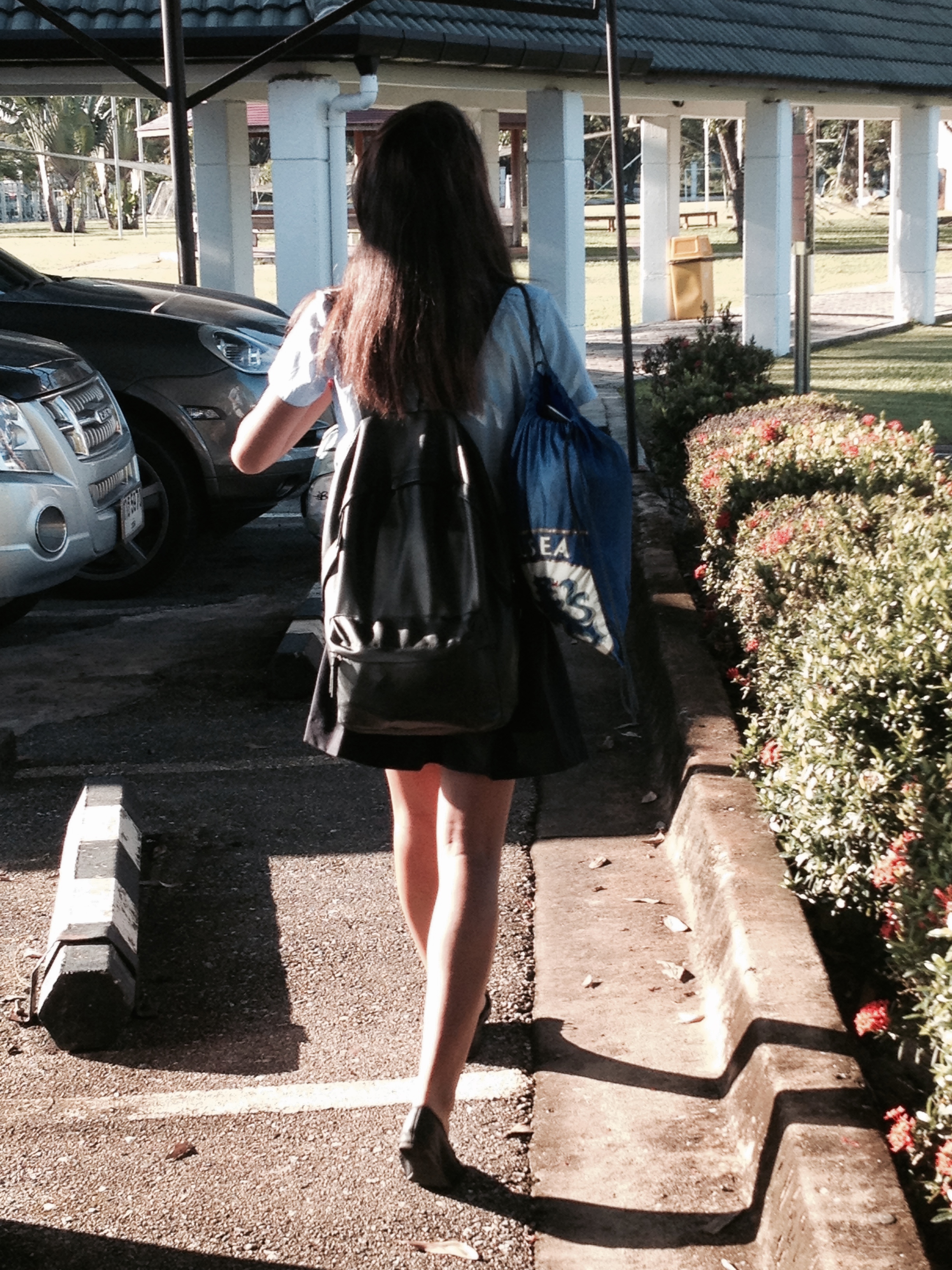
Raising self-sufficient kids

My mother always made excuses for me to absolve me from doing chores and even from thinking.  She always had the perfect excuse: I had homework to do, I was tired, it was faster if she did it herself anyway and a whole host of other excuses, when it came to washing up, taking the rubbish out, cleaning my own room, right down to fetching myself a cup of tea. In her simple, generous and selfless mind, I always had other more important things to do.  I was going to be an important person in the future, destined for greater things, and thus, my every moment should not be wasted on menial tasks and mundane things.

It may sound idyllic, but my mother had robbed me of learning opportunities. I never learned to be self-sufficient. All I needed to do was use my voice.

The career paths I had chosen did not help me either. From my twenties onwards (apart from my short PhD years), I had nurses, secretaries and maids running at my every bidding. I always had people to file things away, sweep up my crumbs, wash up after me, run my errands, open jars and load syringes. As I grew older, I morphed from a pampered kid into an arrogant adult who hid her insufficiencies behind her successes. My excuse – nay, make that self-justification – was, I was earning a six figure salary, why should I know how to change car tyres? I needed hired help, to free me to do the ‘more important’ things in life, such as playing with my children, cooking wholesome food, reading, partying.  That was all good at the headline level, but filter that down to day-to-day living, it became a crippling shortcoming. Examples: because I no longer have a personal assistant, I have missed the same flight three times in the week, I am always going overdrawn in my accounts because I am bad at keeping track on my spendings, I do not know how to operate household appliances, I leave my kitchen mess for others to tidy up, I can never find my own things … need I go on?

In the beginning, I tried on this ruling class mentality with my children’s father, but got nowhere. He was the only one who was not prepared to jump over hoops at my bidding. Indeed, I often credit him for teaching me life’s lessons, including one in self-sufficiency.

Kicking and screaming, he had dragged me into the real world. I had learned how to change fuses and clean our house (on the first night I slept over! I am still reeling with shock about it). But almost thirty years of unsympathetic lessons from this taskmaster, I still have the occasional bad habit, like handing a banana on auto-pilot for him to peel.

I arrived home in England and all the old-time bad habits surfaced once more. My passport. It was out of date. Can you imagine, I managed to get through immigration with an out-of-date passport, but fortunately, Border Control in the UK side allowed me in. My family’s office scrambled into action.  The appropriate forms were miraculously pushed into my hands, appointment for Priority Service made, proxy letter written and printed (for someone to go and get my new passport), directions to the local photographer given … all I had to do is walk the 200metres to the photo shop.

But see the post-it stickers? Yes, I am that incapable.

And having learned from the previous generation’s mistake, my girls were brought up very differently. Oh yes, their father made sure of that.  Despite her delicacy, Kat could change car tyres and U-tubes (kitchen sink). Despite her lack of domesticity, G could fix herself a nutritious meal and self-medicate (at 14!). And even though she spends a lot of time on the football field, she stays on top of her schoolwork with zero interference from us. As she often comments, “I brought myself up.” That’s what happens when you have a mother with a disability in the real-life department.

10626604_430910057049659_1422669222916429186_n

A positive parenting/teaching style

Screen Shot 2014-09-09 at 10.51.52 PMA few days ago, I posted about G’s father trying to help her with her homework, and although her father has a degree in Mechanical Engineering, had worked as a research engineer at the National Maritime Institute, and had taught A level Electronics in some of the best schools in England, she wasn’t just going to accept his word unquestioningly.

“I disagree with why you have to convert everything out of Newtons, Dad,” she said sullenly. “Seems a dumb way of doing things.”

My post brought in several messages from Asian mothers along the lines of “Aiyoh, you allowed her to challenge her father?” and “Your daughter must learn some humility.”

I agree, in part. Being a secret Tiger Mum myself, I could not have taught this child. And I am glad she has a father who has the patience of a saint, and a school that supports her learning style.

Today, I sat through a presentation by the Head of her school, the British International School, Phuket. Mr. Neil Richards spoke passionately about his vision. A couple of the things that resonated deeply with me were the following words of his:

 “I am committed to giving your children as many opportunities as possible to express themselves” and “Taking them beyond examinations.”

Yes!

Too often, schools and education systems (and by extension, teachers) are focused solely on getting their students to pass exams through memorising and rote-learning, thereby robbing the next generation of the opportunity to use their brains productively and richly. Learning to score top marks in exams without understanding the rationale behind the subject constitutes a narrow band of learning how to solve specific problems only, which given enough time, even apes can do. You don’t grow your brain by drilling for hours on past exam papers or memorising things that make no sense to you, just because some long-dead Professors said so.

“Teenagers are messy, they are control freaks. It is part of their DNA to want to take control back from the parents. We allow them to do so, but not too much too soon.” Wise words, Mr Richards, and the questioning, challenging and debating are all part of the process of making sense of the world around them, which they will be custodians of. We want to raise thinking leaders, not meek sheep.

My Richards spoke of his belief that Success = Attitude + Teacher + Ability. And surprisingly, Ability is only 20%, according to his 20 years’ experience as an educator. He believes strongly that all learning is emotional. How a child feels inside relates to how he will learn for the rest of the day. A child who is comfortable and happy in school will learn better throughout the day. And perhaps even influence his life’s choices.  Mr Richards himself was influenced by Mrs Griffiths, the history teacher who taught him when he was eight, and the positive influence she has on his life. And all Mrs Griffiths did was made the eight year old Neil Richards feel confident in himself academically.

The British International School in Phuket has succeeded in implementing its Head’s vision of creating a happy, comfortable place. The environment is indeed collegiate, non-threatening, sunny and relaxed. G, in her second week at the school, was not too intimidated by her new environment, and dared to put her hand up in class to correct her teacher. I give full kudos to that particular teacher, who was gracious enough to check the answer on the Internet, and concede that G was indeed correct.

G feels good in the school and I am confident that she will achieve great things, though she comes home and says that her teachers goof around in class. Today, I will tell her what her Head said, that this is all part of the grand plan.


Footnote: I am working on an article about teaching children how to think.  Follow this blog and read it, if you believe in raising thinking leaders, not meek sheep. And get ready for the questioning, the challenging, the debate. 🙂

She does get away with more that she should

I insist on politeness. Rudeness is a red card offence in my house, i.e. immediate banishment to room, grounded for the weekend, no internet, etc.

But my children, especially G, are not the type to accept meekly (and I am glad). We pay for international school education for precisely this reason: so that they are encouraged to think, question, challenge, debate, learn …. of course, in the politest way.But here are the unspoken subtexts behind G’s words spoken with her oh-so-British accent:

(1) “Dad, I don’t get your point” actually means “Do you seriously know what you are talking about, because I doubt it.”

(2) “If I may have my say now please” actually means “Shaddup, you waste of space.”

(3) “Is it really?” actually means “I don’t think so, pondlife.”

(4) “The person who wrote this book is wrong” actually means “There are so many farking stupid people in the world today.”

(5) “Please allow me to show you how it’s done” actually means “Move over, loser”

This is why I cannot teach her. Because her words and tone of voice is a model of politeness in itself – thus I cannot censure her – only that I can hear the subtexts. Which is not good for my blood pressure.

The child with the cut-glass British accent:

http://www.youtube.com/watch?v=8RFONbabE6A

Screen Shot 2014-09-11 at 10.31.27 AM

Conversations in the car

Screen Shot 2014-09-09 at 9.14.20 AMI think this is the most important part of a child’s day, because you make them feel loved and also they learn communication skills. So with the other children, we had a policy of never having the radio on in the car on our drives, but to make the conscious efforts to talk to each other. With G, we turn up the volume to give ourselves respite, but she still talks over the radio. This was yesterday afternoon’s conversation:

G: “Momdad, let’s talk economics.”

Us: “OK.”

G: “At school today, I just had to spend a little money at break to buy eight dim sums. Because I get lunch for free. It is all included in the school fees, remember? So I had lots of ribs, I skipped the rice. And finished off with banana fritters with chocolate sauce.”

The father: “In that case, we are net-positive then, since we only paid for a little snack and you chowed down so much.”

She whipped out a piece of paper from her bag. ‘Not so fast, Dad. Here’s the note from my maths teacher: you have to buy me a calculator that costs THB5,900 for my maths class. And the bursar said you only paid THB15,000 out of THB75,000 for my International Awards. So you still have to pay the school THB65,900. That’s 1,275 pounds by the end of the week. There is no such thing as a free lunch, folks.”

My article on growing your child to get 100% through conversations is published in Huffington Post: http://www.huffingtonpost.co.uk/jacqueline-koay/the-scenic-route-to-getti_b_5770398.html

The Scenic Route to 100%

IMG_7193

It’s a well-known fact: Asian parents are hot on education. The type of education that means anything less than 100% is not acceptable. A friend from my hometown (Portsmouth) taught Math at a top international school in Asia. He said parents would often ask him, “How can my child improve on his grades?” Err, the kid had 95%.

Into this hot-housed world we arrived a few years ago with our weird values of raising happy strong children, never mind the grades. Georgina could not read at 5, but she was a glorious, delightful child. Here’s a video of her at 5: http://www.youtube.com/watch?v=8RFONbabE6A

She took her own sweet time. For the longest period, her father read to her every night. He read her every book in Fairy series (from Bethany the Ballet Fairy to Gemma the Gymnastic Fairy to the 200 fairies in between the ballerina and gymnast). Father and daughter then moved on to Jacqueline Wilson’s books. The father was so into the books which he read to his daughter that once, forgetting himself, he got very excited about meeting Jacqueline Wilson. Poor lady must have had a shock when a middle-aged man came up to her and gushed, “I love your books!”.

G finally decided to read when she was around 11. ‘I could read from when I was small, you know,” she declared. ‘I just pretended I couldn’t, that’s all.”

It made no difference to us. Because she learned a lot of other important things the natural, organic way with the time that was available to her. She grew into a strong girl with a good understanding of the world. She has such enthusiasm for life and forms her own opinions from the thousands of questions that she asks daily. She was (is) excited about learning new things, has an inquiring mind, is eloquent, sharp, witty and quicksilver bright. And when the time was right for her, she began reading. Mein Kampf is one of the books she is reading, because she is interested in the politics and the wars in today’s world. Slowly, steadily, she climbed up the rankings. All on her own steam. She got into the top set for all her subjects, and that is at an academic school where tuition is norm. English and Music are her weakest subjects.

“Don’t blame me,” she said with her usual insouciance. “My dad speaks bad English.”

I sighed. “But Music, G! Your dad is a guitarist in a rock band, and you got 0% for your Music exam!”

“I only do Rock,” she said belligerently. “And that’s not on the curriculum.”

But she excels in Math. “Momdad, I have beaten all the Asian kids. Even those who do 10 hours of tuition a week.”

Do I sit down and teach her Math for hours on end? No. But I wrote about the ten most beautiful equations in the world. I am always pointing out to her the Fibonacci sequence in the natural world. I told her about Pythagoras and the cult he founded. We talked about Fermat’s Last Theorem (which took centuries to be solved). I asked her if it is ever possible to find Theory of Everything, the one equation that describes “everyfink”.

None of it is related to ’exam’ Math.

Last Monday, she started at a new school. She had to do a Math test for streaming purposes. She was totally unprepared for the test.

She came back in a foul mood. “Half of it was on Probability! And I didn’t do them at the old school. Well, other people probably did, but I was out playing football. I must have missed it.”

The result came back 2 days later. She had 100%.

Her father was annoyed at her for getting 100%. After the fuss she kicked up. “I thought you said you hadn’t covered Probability?” he said. “You lied.”

“I didn’t!” she protested indignantly. “I have not covered them before! I just worked them out. Probability is like the gambling stuff, right? You just work out how likely somefink is going to happen or not, that’s all. So what’s the big deal?”

As my friend Azlan Adnan said, “This is what education is all about – empowering people to work things out from first principles using logic, which is the highbrow word for “common sense,” which, unfortunately, is not very common nowadays.”

And so, here’s our scenic route to 100%. Not through rote-learning, tuition or hot-housing, but through conversations with our child – she was about 6, when we asked her to tell us 10 reasons why it is not a good idea to build houses on a cemetery that is not related to ghosts. It was a good conversation.

Back to School: First Day Gremlins

I have five children. Georgina (”G”) is the youngest. She is 14. And she is the one causing grey hairs to sprout abundantly from my scalp, if old wives’ tale about correlation between lack of follicular colour and stress is to be believed.

10410620_417562521717746_4763172011780216952_nToday was her first day at a new school after the long summer break. I got up early to have breakfast with her and to kiss her goodbye at the door as per the perfect family scenario.

But instead, we stood across the room from one another, the chasm as wide as our generation gap, snarling like a pair wild beasts. I was quoting the school rulebook aggressively at her, whilst she obstinately stood her ground.

For starters, her skirt was far too short. School rule says, the hem must be skimming the knees. Hers was sitting defiantly somewhere mid-thigh, showing off her long coltish legs. Yes, she had done what bold schoolgirls from previous generations had – she had rolled up a good 10 inches of the length at the waistband.

“So?” she said with a jut of her chin. ‘You can’t see my knickers, can you? And anyway, I am wearing shorts underneath.”

“You have to make your skirt longer,” I said in a voice that invited no further discussions. “Because it is part of the uniform rule.”

“And why is that so? What is the rationale behind the on-the-knee rule? You can’t see my panties at this length. It is not even a safety issue in the labs to wear shorter skirts. And anyway, some teachers wear skirts that are much shorter than this.”

And then there was the make-up. Lashings of mascara and eyeliner. And lipgloss (“Mum, it’s for moisturising my lips, you don’t want me to have chapped lips, do you” With saccharine sweetness).

And the multiple ear piercings (“OK, I will take my ear studs off when I am playing sports.” Grudgingly.).

And the colourful bracelets (“They are for religious reasons,” said this heathen child. “I got them from the monks in Cambodia, and it’s bad luck for seven years to remove them.”)

Her father, watching from a safe distance, said, “Let her teacher deal with it. After all, it’s the school that sets the rules, so let a member of staff justify those rules to her.”

Then, damningly, he added, “I actually agree with her.”

I stared at him in disbelief. “You can’t subcontract disciplining your child to teachers. It is our responsibility as her parents to raise her right.” That’s the Asian Tiger Mum in me speaking. The part of me that expects unquestioning, blind obedience, on the basis that I am the parent, therefore I must always be obeyed.

But fortuitously, recent stimulating conversations with my neighbour Richard Boyle short-circuited the part of my brain that is conditioned and sleep-walking, to jolt the slumberous thinking part that my parents had invested a lot of money (three years at Oxford) to cultivate. Richard and I had been discussing the masses’ readiness to obey governments unquestioningly, blindly (is it laziness, fear, or lack of self-empowerment?) We concurred that one does not have to be a rebel or an anarchist to question instead of obeying blindly. It is about exercising one’s brain, it is about doing audits, it is about functioning as check-and-balance, it is about being alive, instead of going along like sheep and lemmings with the decisions of the minority who rule.

For example, did you question, protest or think about fluoride in drinking water? Or did you accept the PR line that “It’s good for teeth”? What do you think?

And so, having taken some time to mull over it, I think that raising a child right entails teaching him or her when and how to question authority – politely and constructively, of course – because it is part of the learning to become a thinking adult and a responsible member of society.

This child of mine is fortunate that she has had far-sighted teachers in the past who had supported her mental growth. Most notably, Mr. Jonathan Booton.

At 10, G had marched up to him and asked, “So, Mr B., why are there new dustbins in all the classrooms on our floor?”

Jonathan Booton, without missing a beat: “To justify the exorbitant school fees that your parents are paying.”

Yes, I blame him. With great affection.