Of fussy-eaters and two way respect

My 60 kg 16-year-old daughter is strictly a carnivore. She eats greens under sufferance, namely to neutralise the acidity of the meat she eats. She often blitzes these greens up into a smoothie, fibre and all, and chugs them down. I have her sports to thank for that. As a footballer playing in high level, demanding international tournaments, she has been taught how to pay close attention to her diet. She herself can see the consequences of not eating well.

Since commencing football training four days a week and following a professional programme, she has filled out nicely from a skinny 14-year-old into a powerfully built 16-year-old:

Screen Shot 2016-06-01 at 0.39.13.png

Georgina has an informed and healthy attitude towards food (she does not drink, do drugs, smoke or stay out late because of the strict Academy rules) though she eats more meat than I would like.

I, on the other hand, love my greens. I could eat salads all day, fresh greens with just a light, homemade dressing. I would rather my family just eats greens, no meat. Indeed, in my militant vegetarian days in my misguided youth, I used to enforce a no-meat policy in the house. Looking back with hindsight, I realised it was the wrong decision in my household as a family who values kindness and Self very highly. I should not have tried to impose my ‘right beliefs’ on my loved ones, in the mistaken belief that I know what is best for them.

These days, I honour my family’s tastes and choices, but at the same time, I integrate my own wishes and likes into the food I make. I strongly believe that food is a two-way respect thing, not a warring turf. Unfortunately it has been that way in many families for decades – food has been used as an emotional blackmail tool and we often have unhealthy relationships with food stemming from our childhood battles with our parents and from our parents’ unhealthy attitude towards food.

Georgina has several friends who suffer eating disorders in varying degrees of severity, a couple of them requiring hospitalisation. The biggest tragedy is one who lost her life to anorexia. I do not think good eating habits alone can prevent this, but I do believe that good eating habits fostered at a young age goes a long way towards keeping children healthy. Here are my tried-and-tested tips:

(1) Never fight over food. That’s why it is important to exert your authority in this matter when your children are still young.

(2) Introduce children to a wide variety of food at a very young age. I don’t believe in cooking special food for 1-year-olds. They do not need special porridge or special bland food. They can eat what we do and they jolly well should. Just be careful about fish bones and small things like peas and sweetcorn that are choking hazards, and ensure that there is not too much salt in foods.

(3) Terrible Twos is the stage when food battles begin. This is the time to manage it right. Never allow a toddler to win the battle of wills. Be firm (but not unkind or dramatic). When I was in my early twenties, I had three children under 5 years old and was a full time student at University. There was no way I had the time or the patience to pander to food squabbles. My children simply had to eat what was on the plate. No force-feeding and no chasing toddlers with food either. Make the dining table a fun and happy place to be and everybody will eat well.

(4) If they choose not to eat then they can go to bed hungry. They won’t die or suffer malnutrition overnight.

(5) Foster good eating habits in the home.

(6) No snacking in between meals.

(7) Ensure that children understand the consequences of their food choice but no empty threats (for example, if you don’t eat carrots, you will die).

(8) With older children, have a dialogue with them. No drama. I respect your food choices, now you have to respect mine. It is give and take always, as is everything in life.

Here’s my burger, loaded with nuts, seeds and vegetables:

IMG_2254.JPG


She conquers the world

My Ma expressed some concern that my youngest daughter Georgina, who is in the midst of her IGCSEs, is helping me with my new parenting book and that she has a full-on football training schedule. And a busy social life to boot. My Ma – who is a strong proponent of the theory that all human beings need to live happily is fresh air, love and sunshine – thinks that her youngest grandchild has too much on her plate.

“Oh, Jac, you weren’t brought up like this at all,” my Ma admonished me. “You were on the beach before your exams!”

But, Ma, I have a child who is wired differently. She has her snout in many pies, by her own free choice, and thrives on the pressure and challenges. What stress?

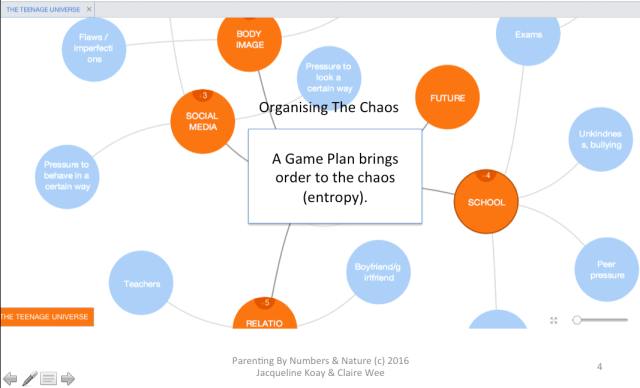
“With smart organisation, you remove stress,” Sixteen year old Georgina explained patiently. “A Game Plan brings order to the chaos.”

Screen Shot 2016-05-25 at 10.57.50.png

It is indeed true. I was at University with three young children and no helper. In those days, I had to be very organised. Monday was washing day, Wednesday was catching up with University work day and Saturday was house-cleaning day and preparing freezer bags of food for the following week. It was only by being super-organised that I managed to survive those years and get a degree to show for it.

But often, children and teenagers don’t know how to organise themselves. This is largely due to helicopter-parenting: control-freak parents micromanaging children to the extent that children stop thinking for themselves. What is the point? Mummy/Daddy has planned the day down to the last hour for them. They just have to show up for the free ride, no need to switch the brain on.

In the parenting book that Georgina and I are working on, I explored this issue of disempowered children. How to cultivate motivation and initiative in children?

“Get off our backs for starters!” Georgina exclaimed. “Give us space.”

Yes, we used to allow her to wear her mermaid outfit everywhere, even to bed. It got dirty and tatty, but she still wore it. And we allowed her to. Why not?

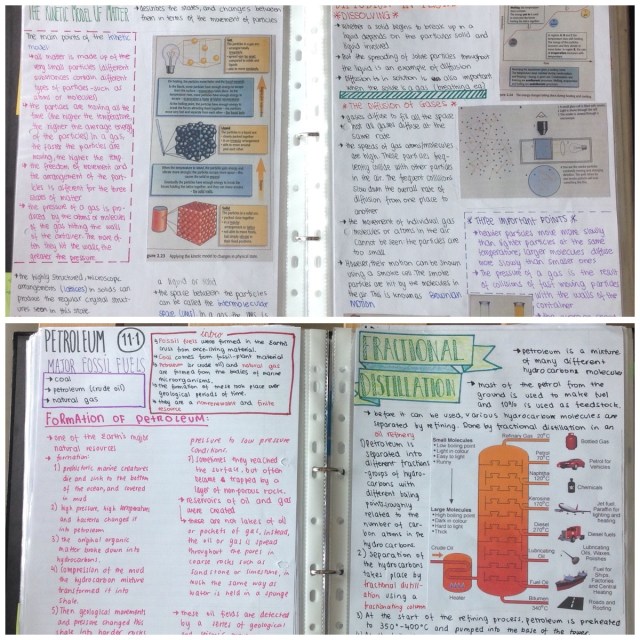
Georgina spends a lot of time making detailed notes. Though she has told me to get off her back, I could not help but ask, “Aren’t you wasting your time, spending hours making pretty notes instead of studying?”

IMG_9749.JPG

“I’m organising my brain, Mum!”

OK, point taken. But why don’t you just read it from textbooks?

“Because the act of writing down the concepts in my own way and in my own words forces me to understand, Mum. I write down notes in class too which I often don’t look at again, for the same reason: it forces me to understand.”

Maybe not having an iPad throughout the years helped her in developing a good relationship between her brain and pens, pencils and paper. She is actively engaged whenever she is faced with something rather than passively entertained, be it studying or her social life.

Recently, I interrupted her whilst she was studying. She was wearing headphones.

“Can you concentrate whilst listening to music?” I asked curiously.

“It’s white noise, Mum,” she said. “It helps me to concentrate better.”

I listened in. Yikes! I had a blinding headache coming on immediately!

She grinned. “You see now why it focuses the mind?”

Our children are not us. They are wired differently from us. This is also their world. The future is theirs. And I think we have to trust them to find their own way, even if their way seems illogical. Dig deeper and often, you will see beautiful logic emerging from the madness of a teenage brain.

Work hard for the right reason


It’s no secret – I detest work that requires sitting down and I detest work that requires using my brain. These two traits were the cause of my dismal exam results: I managed three ‘O’ levels despite going to an expensive private school and those three ‘O’ levels were in subjects that required literally no studying: English, French and Mathematics.

Though my Ma did not give me a hard time over it, in later years she confessed that she was shocked that I did not even manage a ‘C’ for Biology. “You knew so much,” my Ma said.

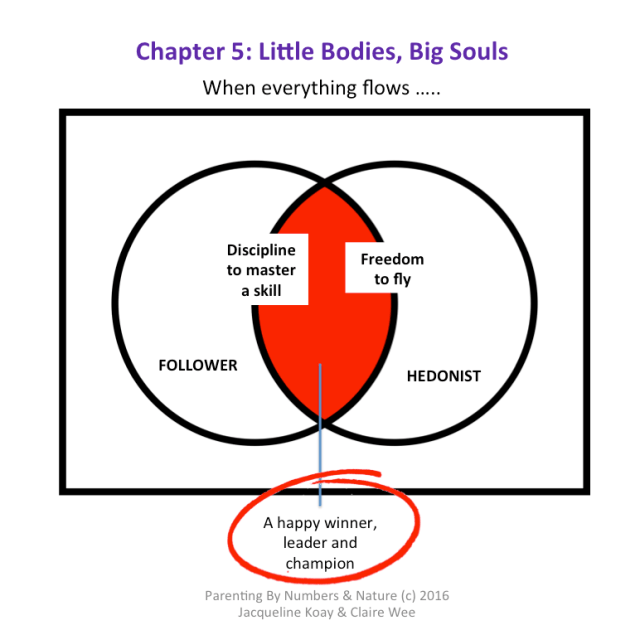
Well, the reason was, I never had the discipline to study.

In my parenting books, I enclosed this diagram:

Screen Shot 2016-05-24 at 9.56.52

My Ma never forced us to do anything. She used to say cheerily, “Ooooh, when you are an adult, there will be so many people telling you the things that you can’t do, or things that you have to do. So enjoy what you have now, dearies.”

Thus, we had a magical time growing up. I will always remember the closing years of my childhood sitting on the beach with my younger brother when we were supposed to be studying for our ‘A’ levels, and going to the Polytechnic library to waste time instead of work.

Whatever issues that arose from my Ma’s magical ways were laughed off with her cheery, “Don’t worry, it will all come out in the wash.”

Maybe we were just plain lucky or maybe my Ma had been right all along, but all her children turned out just fine academically and in our careers.

Because you see, though my Ma was easy-going with us when it came to ‘unimportant things’, she taught us very strong work ethics, moral courage, inner strength and commitment where it matters. And where it matters is human relationships.

I began working fiendishly hard when I became a mother and my baby-daddy was a happy-go-lucky chap who did not earn that much (and who had no intention of climbing the career ladder). To the amazement of all who knew me, I won a scholarship to Oxford. Whilst at Oxford, apart from the burdens of studying and caring for three young children, I worked in part time jobs to supplement the family income. I worked hard in my career too, not for my own glory, but to provide for my family.


I write this post because very rarely do parents teach children the reason for working hard. These children grow into adults who work for the sake of working. “Can’t see the wood for the trees” as the old adage goes. I strongly believe that if we work hard for the sake of work alone, it is a very empty life. We might get bolstered by our colleagues’ accolades, the financial rewards or job satisfaction, but what is at home and in our hearts? Many true anecdotes abound about men who keel over and die the minute they retire or marriages breaking up when the husbands retire. And even more about driven careerists who did not place enough importance, commitment and hard work into the family, often causing pain to their partners and children.

I believe that we exist to love. Love is the Universal Law. In Mathematics, what an object is is not determined by what it is composed of, but rather, by how it behaves with respect to other objects.

I certainly find that I am more committed and more dedicated to work when there is a human element involved. For example, I am now working fiendishly hard on my forthcoming parenting book that I am co-authoring with someone. It will be her first book and I feel morally invested in making our book a success for her.

If you are looking for something to think about this morning, I would like to urge you to think about raising children to be firmly rooted in love for others, love for themselves, love for the world and love for the Universe.

Photo on 5-15-16 at 21.00.jpg

No need to move to Finland

It’s easier to think that the solution lies in the external rather than realise that you create your environment. Many people think that if they move house, move neighbourhood or move country, they will be happier. I have known people who complain about their houses, their neighbourhoods and their countries of residence, who then move and find out that the land-of-milk-and-honey is not what it is all cracked out to be. The streets of London are not paved with gold. Happiness and contentment starts with YOU.

The news and articles that had been making its rounds in recent times is how Finland tops the Global Education Ranking (as the US declines) by its daring and innovative education policies. Oh, the number of parents who tag their partners with the comment, “Let’s move to Finland.”

Uhm, can you stand the long hours of dark in the winter or the high cost of living? I strongly believe that we do not have to move to Finland to give our children the benefits. After all, school is only half the story. What you create in the home is every bit as important, if not more. A teacher once said, “A child who gets his education only from school is not educated.”

o, what’s so special about Finland’s education system that gets so many parents dream of packing their bags and relocating?

No homework. Shortest school day (20 hours a week for younger children including lunch hour) and shortest school year. You learn more by going to school less because your brain has to relax to be more effective.


13221004_664412977032698_3235170159808043950_n

OK, you cannot dictate the school hour and the school year. But aren’t you adding on to your child’s burden by tuition?Our policy in our house is, no more than 1 hour a day during the week for homework, project work and studying. 2 hours maximum at the weekend. She has to learn to work efficiently. And here she is on a Sunday morning, making use of her 2 hours. You know what is the surprising thing? She has an exam on Monday and here she is, working on something else not related to her exam.

“Shouldn’t you be studying?” I asked, playing the devil’s advocate.

“Finished,” she said. So yes, 9 hours a week is plenty.

Another thing about the success of Finland’s education system: children are given a voice (yes, they learn respect too). The children help to design the school playgrounds with the architects who consult them. Wow, great! But your child’s school is not progressive, right? Well, neither is my child’s. But hey, you know what? You can foster that same accountability and creativity by allowing your child to choose his/her own wardrobe and bedroom design. Allow some freedom of choice, relax parental control-freak tendencies – your child goes a long way.

Screen Shot 2016-03-23 at 17.00.28

Most of all, the implementors of Finland’s successful education system talked about happy, happy, happy. The Principal of my child’s school talks about happy, happy, happy, too. He said he told his staff to make sure that they have a good relationship with the students; learning comes second because a happy child learns more. So what does it take to make a child happy? I would say, it starts with happy parents and happy household. It’s not about moving but about you and what you create.

Mummy Army Rules!

When I was young, we had a collection of books called The Encyclopedia Britannica. I still remember the thick, leather-bound books that sat in the study in my parents’ house like stout pillars of knowledge. They contained everything in the universe that you could ever wish to know.

Now, the company is out of business.

Wikipedia is here. Hold up your hand if you use Wikipedia. I certainly do. I love it because it is the work of millions of people. Yes, we all contribute to this huge, living and growing Fact-Tree. No wonder Encyclopedia Britannica went out of business. There was no way expensive static books could compete with free, ever-growing tree of knowledge.

Wikipedia is the ultimate in collaboration. And collaboration is in the human spirit at its purest form. We want to reach out and pull each other up, it is natural.

Yesterday was the day I gave away free downloads of my parenting book. I did lots of preparation beforehand, from making video tutorials on how to download Kindle to where to find the book, but there was no foreseeing all the issues that will arise on the actual day. There were 639 questions coming in fast and furious, ranging from the highly technical to the “What is Kindle?” and “How do I find the Kindle Store button?”

If it had been a conventional business, I would have had to set up a call centre or annoy a lot of customers. But in this wonderful community that I have established through my tireless blogging and Facebook-ing, an army of mummies (my so-called Mummy Army) marched out in their numbers to help each other. They were patiently explaining the steps to each other, they were troubleshooting and posting screen shots, sharing and joking with each other like old friends. Something very beautiful was happening in our cyber world yesterday. I wish I could bottle the essence.

I was exhausted, jubilant and humbled at the end of the long day. And filled with ever so much gratitude for the beautiful spirit of collaboration I had witnessed. My daughter Georgina, the subject of my parenting book, was doing her exams all day – I would love for her to have been here to experience the beautiful solidarity and power of working together to realise a mutual goal. I believe it is a very important lesson to for children to learn. Collaboration is the lifeblood of many successful ventures. My son went to Royal Naval College Dartmouth and I believe he was taught that. I learned it sitting in my office which is a beach shack, courtesy of my Facebook friends and fellow bloggers.

Yesterday, we pulled off something amazing. My book got to #3 on Kindle Store in the parenting genre. Here’s a big thank you to my Mummy Army.

A day at the office

I spent six years at two top universities in the UK (Manchester and Oxford) but my workplace these days is a beach shack on Phuket island with superb internet connection. My poor parents. But hey, welcome to the new world.

4th of May was not a typical office day. It was the day that my second parenting book, Easy Parenting For All Ages was made available for free download on Kindle. It all started in 2012. I wrote a parenting book called Barefoot In The City. It sold 5,000 copies in the traditional hard copy format and went down the route of conventional books with a book launch party (in the rainforest), book signings and book events. It became a much-loved book because I had successfully built a community around the Barefoot philosophy. The community is still going strong on Facebook and my blogs. In a sense, the followers had become real friends.

Four years down the road and the subject of the book, my youngest daughter Georgina, was about to turn 16. She said some scary, truthful things such as “You can’t stop teenagers doing what they want. We can always find a way if we want to.”

Fortunately for us, she does not want to party, do drugs, get high, sleep around….despite living in the party town of Patong. She wants to study, play football and occasionally eat junk food and veg out with Gray’s Anatomy. So I decided to write an updated version of Barefoot In The City. Georgina’s father thinks it is very easy to parent her (really?), so I decided to call the updated book Easy Parenting For All Ages. Yes, it has his perspectives too.

A NEW WORLD

I did well financially out of Barefoot In The City but Georgina strongly suggested that the new book be released on Kindle. “Think about the trees and the ink, Mum!” Since when has she become an eco-warrior, or does she know something I don’t?

But I have to live by my parenting creed, which is allowing teenagers to take the lead. So dinosaur, un-techie mummy ventured into the world of Kindle, foolhardy and optimistic. Can’t be that difficult, right? Right? After all, I paid for a professional book interior designer to sort the techie stuff out.

I decided to give Barefoot In The City free with Easy Parenting For All Ages. At a measly $3.99 for both books, I should hopefully recoup what I paid my decorator. Er, I mean interior designer. Note: I didn’t want to charge more because it is a learning experience for me and in case it turned out to be a bad job. I just wanted to recoup the costs.

Screen Shot 2016-05-04 at 14.05.23.png

THINGS THEY NEVER TAUGHT YOU IN BUSINESS SCHOOL

I never went to one but I don’t suppose these were mentioned in MBA classes. Here they are, for what they are worth:

You can never be 100% prepared.

However much prep you do beforehand, there will be issues on the day. Easy Parenting was launched on 30th April, Georgina’s 16th birthday, with a list price of U$3.99. The Free Book Day was scheduled for 4th of May:

Screen Shot 2016-05-04 at 15.40.36

I made a YouTube video and prepped followers on how to download the free Kindle app, where to find the book, etc.

Don’t assume

Global business does not mean global integration. Surprise, surprise, Kindle downloads based in Amazon.com and Amazon.co.uk is not available for download in Asia. I cursed. Because despite all the checkboxes I ticked (WORLDWIDE), it seems that Asia is not part of the world in Amazon-speak.

You must learn to troubleshoot

On the morning of 4th of May, my messaging service, email account and Twitter were full with messages. All saying the same thing: CAN’T DOWNLOAD.

I knew I would be answering at least a hundred of these, so still in my pyjamas, I made another YouTube video. “Good morning, folks. It’s still very early. It’s still the 3rd of May in USA so please wait for Amazon US to wake up before you can get your free copy.”

Not that simple. There is no one solution for all. “I cannot see it on my iPhone”, “I can’t find your book on Amazon”, “Why do I have to pay $3.99?”

And therein lies the two most important lessons learned:

It’s the people that matters

Out of nowhere, the small army of tech-savvy mums began answering the “How do I switch on my computer” questions. They took screenshots, they advised, they encouraged. I was completely blown away, because as a one-woman-show, I could hardly keep up with the questions hitting me every few seconds. I din’t even have the time to pee because if I moved away from my laptop, there would be 30 messages on cue. Yes, at the end of the day, it is the people that matters. The teamwork. The human factor. Sod the book.

You must care about what you are doing

I made it a point to answer every question. Apart from Amazon, I cursed my daughter. She is incommunicado due to football practice and Biology exam. At one stage, I almost phoned the school to drag her out of the exam room to answer the “I can’t find your book on Amazon” questions.

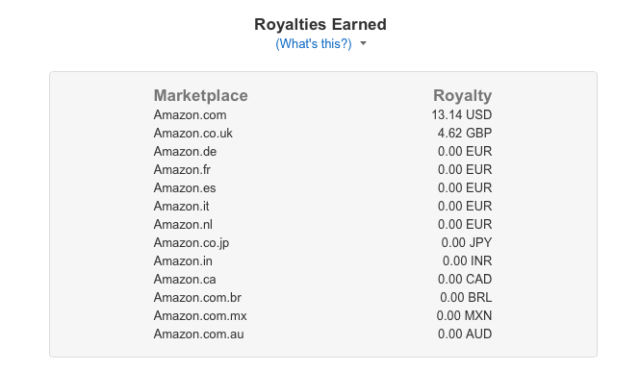
Finally, the sun is setting and my day is coming to a close. And this is the grand total I have earned today, from the few generous who took pity on me and paid for the book that they could have downloaded for free.

Screen Shot 2016-05-04 at 15.31.05

I am happy, because you can buy a lot of beer for that in Thailand. Now let’s just hope folks leave cheery reviews for me to wake up to tomorrow and no “I can’t download!” messages. Good evening, All. x

Screen Shot 2016-05-04 at 17.15.20.png

Healing yourself first

In my parenting book, Easy Parenting For All Ages – Raising Happy Strong Kids, I wrote that how you parent your children will affect the lives of so many. Not only your children’s lives but your own, your children’s spouses’, your children’s children and beyond. Your children are your legacies.

Parenting is more than keeping a roof over our children’s heads, keeping them clothed, fed and schooled. It is about filling their hearts with the good stuff. Because they are walking records of all the things we have ever said or done to them – both the good and the bad. How we speak to our children become their inner voices. Oh, I have heard the voices of parents (especially mothers’) in so many grown adults!

We relive our childhood again and again in our adult lives, in different guises.

The brain is probably the least understood of human organs. Until recently, our knowledge of human behaviour comes from psychologists, but now, the fields of cellular biology, neurobiology and epigenetics have made made significant progress in understanding how the brain works.

Going as far back as Freud and Jung, it is known that we reenact our childhoods. Freud called it “repetition compulsion”. My psychologist, who is also a psychiatrist, calls it “childhood programming”. Basically, repetition compulsion or childhood programming is our brains unconsciously creating the same unresolved childhood scenario in an attempt to “get it right.” This unconscious drive to relive past events could be one of the mechanisms at work when families repeat unresolved traumas in future generations.

I dedicated my first book on parenting, Barefoot In The City – Raising Successful, Free Range Organic Kids to my friend Eva. Eva took her own life a few years ago. She saw many psychologists and psychiatrists in the months and years before her death who tried to help her get over her childhood trauma.

I was so very shocked that she killed herself. After all, there was no reason to. She had an adoring husband, four lovely children, a nice home, a ‘successful’ life. She had always been busy helping others.

Carl Jung, founder of analytical psychology, believed that what remains unconscious does not dissolve, but rather resurfaces in our lives as fate or fortune. I don’t think Eva took the time to heal. And here’s my controversial view: helping others does not heal us. We have to heal ourselves first.

I came to quantum medicine late in life. Schooled in old science, I found the quantum world beyond common sense and beyond logic. But who are we? Human beings are made up of cells and cells are ‘nothingness’. Perhaps just little blips of energy, according to String Theory. Life and reality is not as tangible as we think.

IMG_0773.JPG

Recently, I suffered a huge trauma in my life. My partner, who is all for emancipation of women, started to exert his cave-man rights on me. He insisted that I live in seclusion and isolation for six months to heal myself. He had taken a big house in Phuket on long lease for me.

“Let me go home. Let me be a doctor again,” I railed against him. It has become a bone of contention between us, as I am not used to be treated like a chattel. Logic tells me that I am physically fine now. But my heart, my intuition and my deepest voice tell me to trust this man’s judgment. I do indeed need this time to go inwards, to focus on myself, and to heal completely before I join the human race again.

Behind these high walls I am healing myself.

Healing yourself by quantum medicine

  • Never be afraid to take time out. You are perfectly within your rights to shut the castle doors so that you can go inwards and fix yourself at the cellular level. And it takes time. Those who love you will understand and respect your decision.
  • Shut out all noises. Including your own voice. We need silence more than we think. You need an absolute cessation of mental activities for long periods. Days, weeks, months. Just walk, run, BE.
  • In that abyss, fill yourself with kind words. Forgive yourself. But in the process, also acknowledge your wrongdoings and ask for forgiveness. You cannot move on without making peace with your past, because that is who you are.
  • In your isolation, put down the foundations for a new you. Mediate. Speak less. Stop questioning. Live more mindfully. Love more.

Related academic articles

C. Backster, Primary Perception: Biocommunication with plants, living foods, and human cells, White Rose Millennium Press, 2003, pp. 29, 31-34, 39, 49-50. ISBN 0-966435435.

D. Radin, Entangled Minds: Extrasensory experiences in a quantum reality, Pocket Books, 2006, ISBN 13: 978-1-4165-1677-4; R. Sheldrake, Morphic Resonance: The nature of formative causation, Park Street Press, 2009, ISBN 978-1-59477-317-4; D. Wilcock, The Source Field Investigations, Penguin Group, 2011, ISBN 978-0-525-95204-6


Exam strategy: crisps and TV

photo-618.JPG

“Eat junk food and watch Gray’s Anatomy for 2 hours,” my nerdy Asian kid replied when I asked her what her strategies are for coping with exam stress.

We are currently in the IGCSE exam season and Georgina definitely has a lot on, not only in terms of her studies but also her heavy sporting commitments. She plays football at a very high level and cannot afford to slack off as she is playing in an important tournament in Portugal in less than two months’ time. It is business as usual on the football pitch.

“I’m training kids to be professionals who can earn a living from playing football,” her football coach says pointedly to parents like myself who whinge about his four days a week training regime during the exam time. Surely those poor dears should be in their comfortable homes studying instead of running around in the hot sun chasing a ball?

“Exams are just exams and life goes on,” her father agrees with the coach.

But I am 75% Asian, OK? Exams are a big deal. It is a cast-iron belief that is woven into the Asian genes, like it or not. You’re screwed for life if you don’t come home with a brace of As.

But I was surprised, nonetheless, by Georgina’s response.  She is normally extremely disciplined and controlled, so what is this with junk food and mindless television for two hours?

There are healthy options available in our house and we live by the beach. So why stuff your face with junk food and hole yourself up in your room wasting time watching mindless TV (which she never does), instead of eating a homemade energy bar, swim in the sea and get down to work?

She shrugged. “I give myself two hours. And then I take out my school books.”

She does know what she is doing and what she needs to do.  The walls in her bedroom are covered with Post-Its.

And as a testament to the saying  that we know our own body best, there is a reason for Georgina’s out-of-character behaviour.  Yesterday, I read that Dr Sandi Mann, a researcher from the University of Central Lancashire, and colleagues presented their findings to the British Psychological Society conference in Nottingham which showed that when we are bored, our dopamine level drops and we compensate for this drop in other ways, namely by eating fatty and sugary foods. You can read the short article, Bored People Reach For The Chips, by clicking on this link.

“Bored people do not eat nuts,” Dr Mann said. My goodness, so true! Georgina who loves nuts shuns them when she comes home from school after a long day and still has a couple of hours of studying ahead of her.  Bring on the McVities and crisps.

And interestingly enough, in a separate study, Dr Mann found that boredom can make us more creative. She suggests that boredom can have positive results including an increase in creativity because it gives us time to daydream. Hmmm, television soaps do have their worth after all.

Note to self: my child knows her body and mind better than I do. Note to self: my child knows her body and mind better than I do. It is the innate wisdom called Mahad that I wrote about in my parenting book.

12986999_653201191487210_8325394582742757750_n


With Kindness, Not Love

Many of us, by our thirties and forties, have built and established the veneer and persona of a successful and happy person to fit within the social infrastructure and to gain peer acceptance even if we are a seething mass of unresolved issues beneath the surface. We accumulate those charges against us from our childhood years, from our early relationships, from days long bygone. And often, we do not do anything to heal the old hurts; we just suffer in silence and plaster over the pain. The prevalent belief is that if we are outwardly successful, the old inner pains will go away over time.

Thus, the ignored inner child within us is subdued in this head-led environment, forgotten except in private moments occasionally, because who would want to sound like a loser bleating about Mummy and Daddy and how hurt still we are about episodes that happened decades ago?

A few weeks ago, I was in a therapy session with a small group of good-looking, outwardly successful professionals who were trying to make sense of the bad hand Fate dealt us.

Here’s the story of a 38 year old investment banker whom we shall call Abby. Abby’s father left the family when she was four, and she has not seen her father since. She decided not to let that pain of abandonment ruin her life so she worked hard and became successful at her job. She had several good relationships but never felt the urge to settle down. Then when she was 35, she met Paul. Paul was her Mr. Right in every sense of the word. Though she wasn’t the marrying kind – possessing such a dim view about marriage based on her parents’ – she and Paul began to make plans for a life with each other. They even talked about having a child together, despite her reservations. All was going very well, until Abby’s inner child spoke up and ruined her perfect plans.

Paul was divorced with a young daughter. His ex-wife had met someone whom she was planning to emigrate to Australia with, taking Paul’s young daughter with her. Paul was inconsolable. He sought legal advice, he also thought about emigrating to Australia with Abby to be near to his daughter and remain a part of her life. After weeks of pleading with his ex-wife, Paul was almost suicidal.

But just when Paul needed support most, Abby’s hurt inner child lashed out. “Why are you acting like this? Men are not supposed to love their children. Only women love their children.”

Abby is intelligent. She is outwardly normal. She has a huge social circle. Though her father abandoned her, she had read books and watched movies where men love their children. She even had male friends who love their children. Intellectually she knows that there are men who love their children, but her inner child, not having experienced that love, refuses to believe in it. Her inner child, still suffering from the pain of abandonment 34 years earlier, wasn’t going to lose this opportunity to be heard, whatever the cost.

And here’s the thing: we can’t subdue our inner child forever. Now and then, especially at the most inopportune moment, he/she will lash out. We can build as many layers as we like through self-deluding stories, positive affirmations and outward signs of success, but he or she will break through the barriers, angry and destructive, speaking with the illogicality and unkindness of small children, often ruining the good for no reason, as in Abby’s case.

I am not a psychologist and I know that releasing childhood emotional trauma is a big complicated area. I wouldn’t know how to start advising people, but as a mother of five children, I follow the old adage, it is easier to raise a happy child than mend a broken adult.

Parenting requires some thought, some very deep thought, though many stumble upon it accidentally. And here’s mine from living a well-lived 48 years, 30 of which I was a mother: raise a child with kindness always. I said kindness and not love, because love can be harsh, whereas kindness is always the soft marshmallowy feeling that makes a child feel safe, secure, happy and loved.

But most of all, do be mindful of how you speak to your sons and daughters. Be mindful about the words and the intention behind those words, because your voice becomes your child’s inner child, who stays within them for life. I hear my mother’s and my mother-in-law’s voices in my children all the time. I am blessed that my kids have wonderful voices from their past because that is truly the best we can give our children, this Culture of Kindness.

In the words of Albert Einstein, “Strive not to be a success, but rather to be of value” if you want your child to be truly happy deep within himself as an adult. Outward success is a cold bedfellow when the inner child is still crying out.