Your children, your legacy

If you are a parent, bringing your children up is your most important job, because how you bring them up is your legacy. They are a continuation of your love, your values and your way of life.

I was 17 when I first became a mother.  I did not do such a good job, but I am blessed in that I had a man with deep happiness in his soul to co-parent with me. We also had a lovely, close family who cobbled together to make it work in the most beautiful way (I think it is a combination of Welsh, Spanish and Cockney English that fostered this lovely philosophy of kindness rather than cold rigidity). I relaxed my unrealistic ideals about how children should behave, learned that love is the most important thing of all, and that everyday happiness is to be valued.

Almost 30 years later, I see the product of this philosophy.

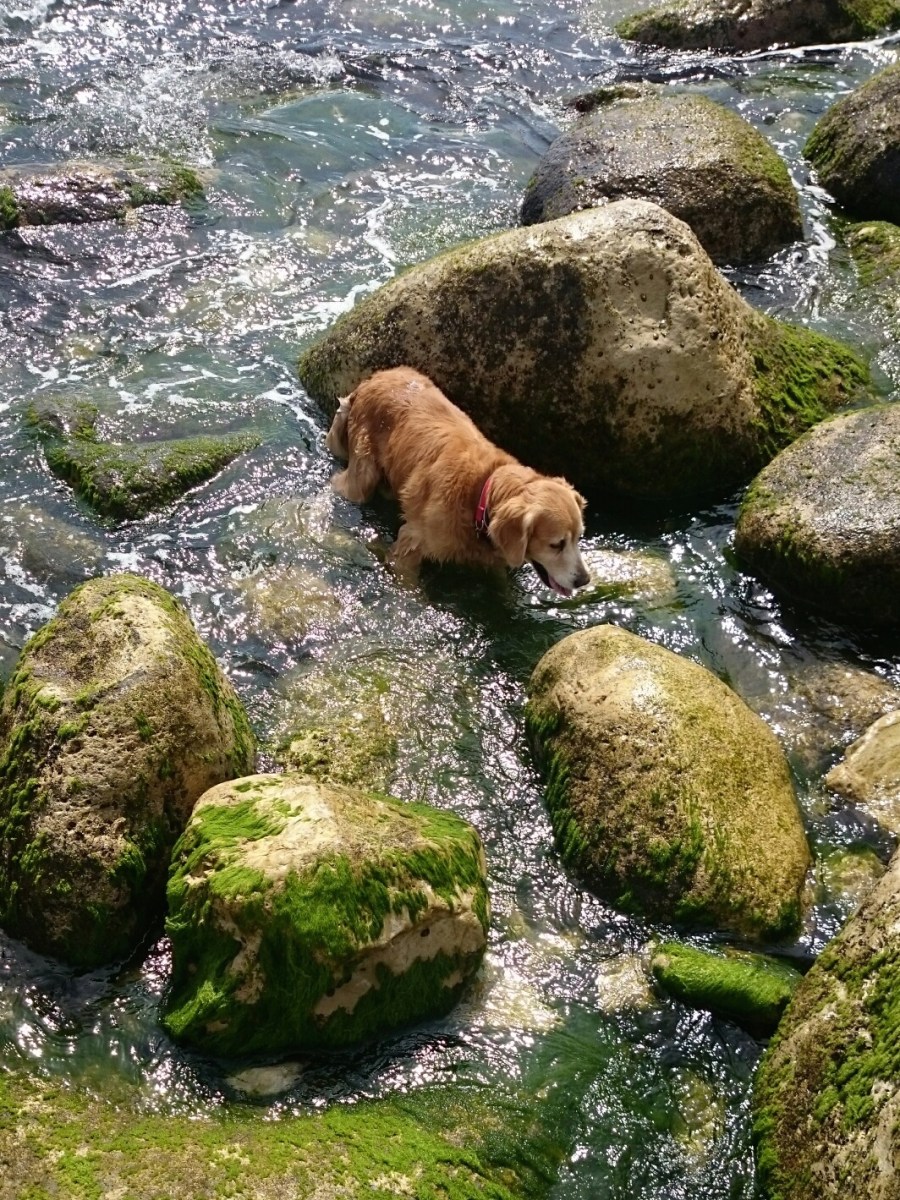
My second son, Kit, is looking after my doggies for a few weeks, and he parents them up exactly the way that his father and I brought him, his brothers and sisters up. The doggies live in a relaxed household with Kit. He made a house for them in the shed, with rugs and a favourite couch, but the doggies chose to be indoors with him and his girlfriend. Instead of enforcing discipline, he moved them indoors without a second thought, because that was how his father and I brought him and his siblings up – they slept in our bed for the longest time, all happy sweaty bodies piled in together, never mind what we read in books about discipline and boundaries.

Kit takes the doggies everywhere with him. In the past week, they have been to Portland beach in Hampshire and later in the week, camping in Cornwall. He could have sent them to boarding kennels, which would have been simpler for him, as he will be on a camping trip with the boys. But his father and I, we took them everywhere with us too because we could not afford nannies and maids. We enjoyed their company anyway – they were fun kids, always full of life and resilient; they never sick, whiny or tired.

Our children were never perfectly behaved, they were not ideal kids by far, and but they were happy. We did our best to keep ugliness out of their lives, though mainstream thinking was that we must be tough to children to teach them how to cope with the tough ‘real’ world.

We chose a life of happiness and trust instead, accepting that life is imperfect and so long as we have 75% good, we are OK.

They have grown up into strong, nurturing adults. I think it is because their father and I gave them a stable childhood filled with love, and the latitude to be naughty rather than aiming for perfection. That little forgiveness and softness is so important, I find, because it teaches children to be forgiving and soft in adulthood.
Love letter to my Mother-in-Law

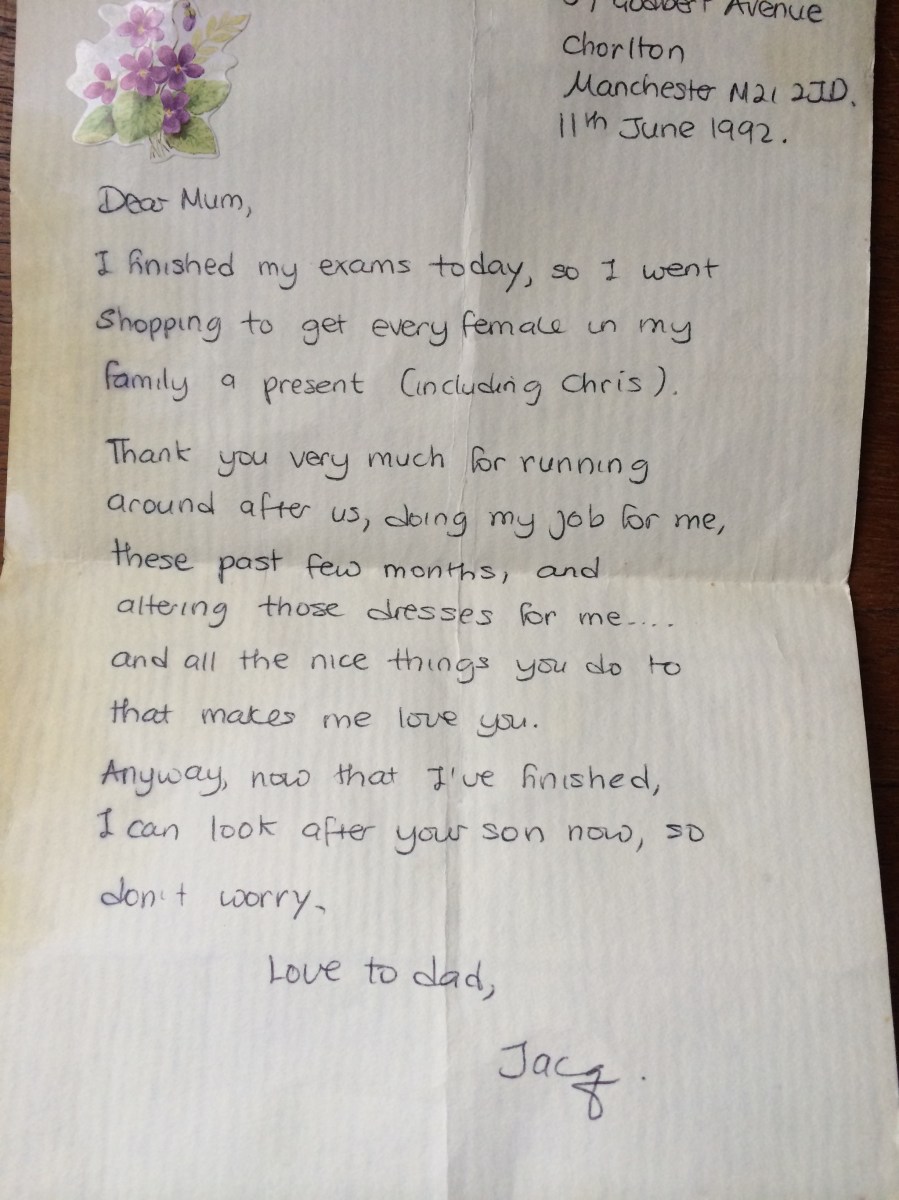
I finished my University final exams on 11th June, 1992. I was no more than a child, still an inner void within me to fill, but I was already a mother to four children who went to University with me and grew up together with me.

It would not have been possible without my mother, who was always just a telephone call and a 3-hour car-drive away. My mother was always there to comfort and cosset. She never criticised, she just loved me unconditionally.

My mother-in-law was different from my mother. She was not as tolerant as my own mother. The summer the children and I had to live in her house whilst saving up for a deposit for our first home was a torture for me. I was expected to work, as opposed to being treated like a princess whenever I was at my parents’ house. Whenever I was in my parents’ house, my mother took over everything so that I could have my much-needed rest from my studies and from being a mother to a large brood.

My mother-in-law cured me of my spoilt behaviour, but it was a baptism of fire. I was lazy and incapable, and her son deserved more than the teenager who was dumb enough to fall pregnant on the first date, and who wanted grand things in life rather than knuckling down to being a mother, taking care of the family the proper way. I should have been thankful for the things I had, instead of chasing silly dreams at the expense of the family.

I used to run back to my mother, crying.

She, my mother, would tell me to learn to love my mother-in-law instead of commiserating with me.

“She’s your mother now,” my mum said, though her heart must have been bleeding at my tears.

And yes she was. My mother-in-law was my mother now. She made my maternity dresses. She was up at 3am with my colicky baby. She took the time to sit in the garden with me in her busy day. She tried to understand me.

Slowly, we began to laugh together. What started as an argument between us would end up in laughter. We began to cherish magical moments together, like sitting with a three week old baby in the rain eating soggy cheese sandwiches, because she was adamant that children need lots of fresh air (even in the rain). Slowly, the enmity turned into a deep and abiding love. It wasn’t an easy relationship, but nonetheless it was one that shaped my life.

This summer, I cut flowers from her garden to bring to her in her nursing home. I found this letter, and it brought it back to me, the love I have for my two mothers, two amazing women, whom I owe everything to. They are still my mothers, and I their daughter, though I am 47 with a string of qualifications, impressive work experience, financial independence and five grown-up children. This positive dependency was brought into sharp focus this summer: though my mother-in-law is no longer capable of looking after herself, I still run to her, as I did this summer, when I needed a home.

Homemade red pesto dressing

Having over-indulged over the summer, I decided to go raw for the next few days.  There were lots of greens in my fridge, but I was bored with conventional dressing, so I decided to make red pesto dressing.  It’s strong and goes very well with olives:

You will need:

1/2 cup sun-dried tomatoes (I used this for a more intense flavour)

1/2 cup pine nuts

1/2 cup grated parmesan

1/2 cup olive oil

3 cups fresh basil

3 cloves garlic

pinch of salt.

I blended the above to a chunky-smooth consistency.  It will store in a sterilised jar in the fridge for a few days – if it lasts that long 🙂

Growing up without plastic toys

I first became a mother when I was 17, and had 3 other kids by the time I was 25. I was an idealistic young mum, spiky and full of definite ideas about how my children should be brought up. I took my children along to university with me, so they had lots of playmates. We did not have much money, so my children had to make do with the little material things we could afford.

I banned plastic toys. I caused quite a lot of bad feelings when I firmly requested no plastic toys for Christmas and birthdays, and made a point of returning them when those requests were ignored by indulgent grandparents.

I became a mother for the fifth time when I was 33. I was more relaxed, less idealistic. And I thought, “Gosh, I was draconian!”

But I was glad about my no-toys stance.

It forced us to do more with our children, though that was a challenge sometimes after a long day at work or university. But the kids learned a very important lesson: they learned to cope with boredom by finding their own ways to engage themselves, instead of relying on us or electronic gadgets to be their chief entertainers.

They used to build houses that they invited us to visit. They used to make dinner for us with real kitchen utensils and fruits, seeds and nuts, giving those dishes imaginative names such as rabbit poo pie. They used to put on performances that they sold tickets for, setting the whole front room up as a theatre. They used to build a rabbit hole behind the settee that led into a wonderland, with my Princess Kat declaring, “Alice did not fall into the rabbit hole; she stumbled into one”. They were so tiny then, with the eldest being no more than 10 at that time.

When they were teenagers, electronic games became a rage, but they continued on their own sweet way. They became experts at Charades and Pictionary, and then of course, the naughty stage of mixing alcohol. My son Jack started a newspaper delivery business with his best friend Anton and my nephew Matthew. My niece Kate, now in her 20s, made food balls for birds to study their preferences. This summer, my 15 year old decided to rewrite school textbooks in a mind-mapping sort of way. Maybe they are out of sync with youngsters of today, but they are fine growing up without plastic toys, expensive gadgets, designer wear or shopping malls.

Being outdoors also gets children in sync with the world they live in. They learn to navigate and negotiate with trees and animals and gravity, they learn to lose their fear but grow healthy respect for danger, and they get to meet germs and interesting things.

Thus my belief: the best toys for children are nature and their peers. Dr Richard Woolfson, a child psychologist, confirms through research that traditional games also bring families closer. In an increasingly isolated world engendered by virtual reality, it is important to be connected in real life to each other and to consciously work on that connection.

This summer, my youngest child was reading ‘To Kill A Mockingbird’ and of course, her father and I unwittingly became involved too, as we wracked our old brains to answer her Why mockingbird? And I realised there is another upside to not growing up relying on Professor Google for answers: my children continue to keep me young. I could not shut them out or fob them off or put them away like unwanted toys – they have become engaging human beings with strong views, vivacity, energy and enthusiasm for the world they live in. But maybe, just maybe, that after 30 years of parenting, it is time to buy an iPad for the 15 year old so that I can shut my eyes on long journeys.

(Photograph: my children, my nephew and my niece playing their own sweet game one fine day in the Alps)

Packing for Life’s Journey

One thing you learn if you are a mother with many small children living in an expensive city like London: you always carry food and drinks in your bag even if it is for a short trip out. Last summer, though my youngest child is already 15 and we have sufficient money in the bank for the odd cup of tea and the odd packet of sandwiches, I still could not stop myself carrying food and drinks in my very uncool big handbag.

At church yesterday, it was a young Filipino priest who gave the homily. He said that in his culture, food for travelling is a big deal. And he asks, what do we carry in our hearts for the journey of life: all the good things like love, compassion, mercy, wisdom, hope…..or heaviness such as bitterness, anger, regret?

It struck a chord deep in me.

Many years ago, whilst I was teaching yoga in NYC, I had a young lady in my class. Her body was tight, tense. She never looked like she was enjoying my class. I largely ignored her, believing that people come to yoga to find their quiet space.

One day, she came to me after class and said “Thank you” for something I said during class. We were doing inversions, and I trotted out the usual yoga teacher dialogue: “Look at the world differently and let go of the rocks in your heart so that you are light enough to stand on your hands. Lose your fear and all the heavy stuff.”

Her story came tumbling out. She was abused as a child, and for 20 years, she had carried hatred for that person in her heart and it stopped her moving on. Inside the grown woman was a child stunted by hatred.

So she decided to try to let go, and fill her life with light things. I like the visualisation of starting today with an empty bag, and going through the day filling the bag up with goodness. The good stuff for life’s journey – big smile 🙂

Light begets light

“It’s ispirazione, not inspirazione, or do you mean inalare?” The man called Antonio Castellano said. I think he was smiling at the thought of my poor mastery of his mother tongue, though scarily enough, most of my outpourings in Italian are about him.

Whatever it is, he is my inspiration (ah, the English language is so much simpler!). And inspiration comes in many forms, at surprising stages of your life. I was a doctor, lacking passion for my job, when I met Antonio on an enchanted tropical island in the Javanese sea, sleeping in little eco-huts under mosquito nets. He had come to the island on his own, to ponder about life’s big questions but ended up inspiring me instead. He inspired me to go back to school to train as a surgeon, to discover my passion again.

He did it with his beautiful writings over the following months. He would type in his Blackberry, or scrawl on a piece of paper, and later, he would read his writings back to me. His writings are self-deprecatory, soul-searching and always honest, and they touched me ever so deeply. I loved the cadence and the silences in his words. Later, in Milan over a couple of winter evenings, he read to me the manuscript that his friend Ambrogio wrote about a war-time love story in Monte Rosa (or maybe Arosa). And in a sense, this is why I write a lot these days, even on my busy days – to continue the magic that I once discovered in faraway Jakarta. His writings certainly changed my life.

There is something about Antonio that struck a chord deep in me, not least because he is Italian, and I am 25% Italiana. That Italiana side of me never achieved full expression until Antonio. But more than that, it is the silence we both share that created something special between us – as young children, we both began speaking later compared to ‘normal’ children. As adults, we still do not speak much, but we began building a bridge into each other. He had always been more adept than I with words, so I began writing ‘Ten Most Beautiful Equations in the World’ for him. Those ten equations now form the basis of the novel I am writing.

Years later, I often asked myself, “Why am I continued to be inspired by Antonio, why could I not get his words out of my mind?” I miss him. I miss his light. And therein lies the answer. His light.

Before I knew him deeply, I wondered where his light came from. I found the answer when I visited him in Milan. On the first evening I arrived, I met all his childhood friends except one (we went to Verona a few days later to meet him). I was jetlagged and ever so slightly intimidated to be faced by a wall of Italian men who had known each other all their lives. But they were grinning at Antonio and I as soon as we walked into the restaurant.

I told them I suggested to Antonio that he coaches football at my children’s school on weekends. I told them that he began going for Ashtanga Yoga in Jakarta. I told them he cooked traditional Sicilian food for me from his uncle’s recipes. They roared with laughter. “What are you doing to our Tony?” One of them said, eyes sparkling, merriness pulling at his lips.

And then I saw it all at once. Antonio gets his light from his friends, from this band of brothers sitting in a closed circle which embraced me, warm and generous, and suddenly, I could picture the boys that they had once been, all innocent and a bit cheeky maybe, but full of openness, generosity and light nonetheless.

Light begets light, and my post today is about wishing you the opportunity to absorb light, so that you radiate it, touching other lives.

The Simple Steamed Vegetables

Dining table battles have been fought over the generations between exasperated parents and mutinous children about eating veggies.  What is it about veggies that some children absolutely loathe? Parents often resort to innovative methods such as ‘hiding’ veggies in meat or disguising the taste with lots of sauces or adding them to smoothies. Hmmm.

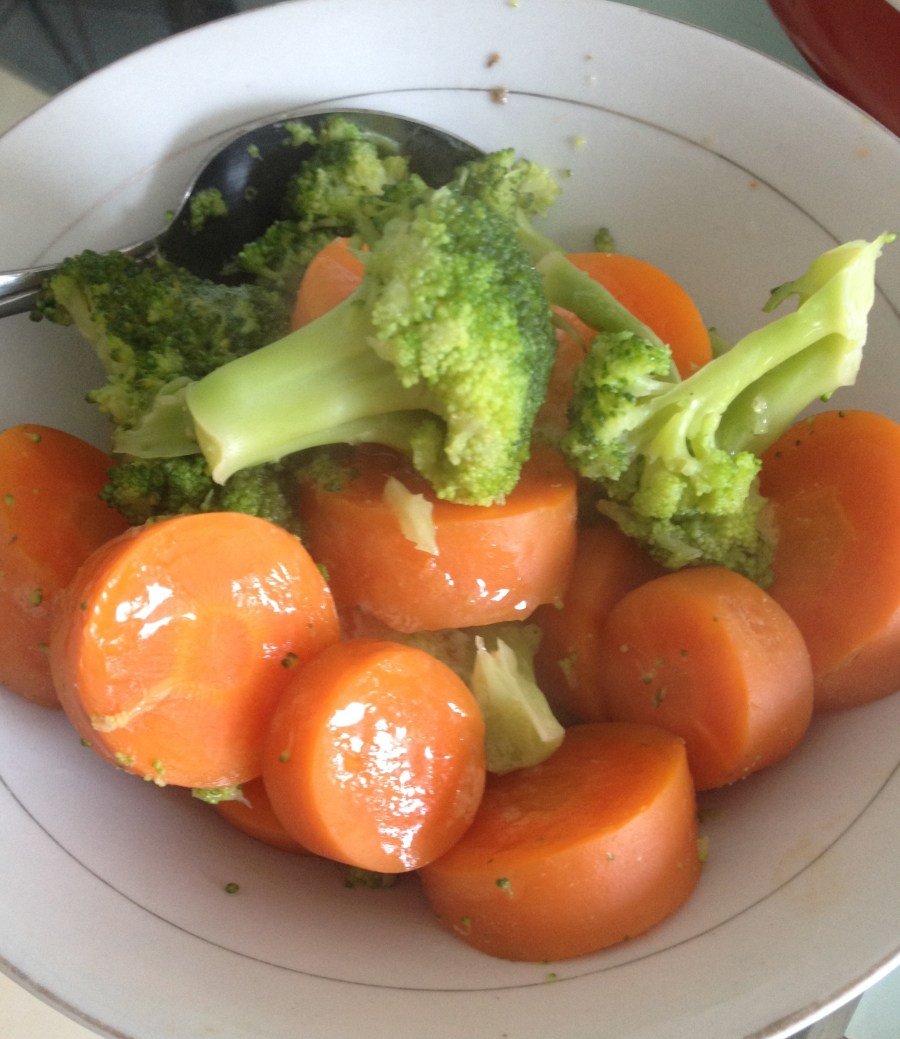
Here’s the thing: there is nothing like the goodness of lightly steamed vegetables.

Steaming vegetables preserves its nutrients, especially the water-soluble ones. Just steam lightly, to preserve the enzymes, too. Indulge yourself by adding a large dollop of butter to your steamed veggies.

Yes it is plain, yes it is bland, yes it is boring,  when pitted against kiddies’ favourites such as bolognaise or the ubiquitous shop-bought tomato ketchup. But I think it is good to teach children to enjoy the simple things, to be conscious of the subtle, and it starts with the tastebuds. Food does affect consciousness and behaviour. All part of awakened living ❤

Creamy Chicken & Capers

Food is cultural and has very deep roots.  I am into Soul Food because my mother brought me up on Soul Food (otherwise known as boring British food) and even now, at 47, whenever I feel battered and bruised by the world, I would curl up with some comfort food and hark back to those safe childhood days.

In my teens and twenties, my cooking evolved to embrace French (I went to a finishing school) and Italian (I am quarter italian) influences.  My twenties and thirties were largely dominated by nursery food as I struggled to feed my growing family on a shoestring and time-deficits. Lately, I have been exploring German food. This was taught to me by my German neighbour in Jakarta, and here it is, with some adaptation.

How to:

Boil organic chicken in water until par cooked (about 30 minutes). Remove from heat and shred the meat.  Reserve the stock. Saute some onions, button mushrooms and carrot chunks.  Add in the shredded meat. Pour cream into the mixture, add the reserved chicken stock until the liquid resembles a soup. Add a small jar of capers and its water.  Simmer until the liquid is reduced to think creamy consistency. Season to taste.

Served with potatoes and steamed vegetables, with a good dollop of butter. The ultimate comfort food ❤

Soul Food: Chicken Chasseur

Continuing from my previous week’s post on so-called Soul Food, here’s my adaptation of the french classic, Chicken Chasseur.  As a working mother when my kids were young, I have always been a fan of one-pot meals, especially those that I can put on in a slow-cooker before I leave for work, and et voila, all ready when we come home, tired and hungry.  As you can see from the photograph, my recipe here uses store-cupboard staples, such as passata, borlotti beans and sweet corn – and of course, frozen  homemade chicken stock that I always keep in the freezer.  If you can, use fresh ingredients, but this ’emergency’ food tastes yummy too.  It’s in the sauce and slow-cooking, I think, and of course, the love ❤

How to:

Brown chicken thighs in olive oil until golden on both sides.  Remove from pan, drain excess fat but leave about 2 tablespoons in the pan. Saute one large onion until transparent. Add 2 cloves of roughly chipped garlic and sauté until slightly softened.  Add button mushrooms and sauté.  Add whatever vegetables you are using.  Add passata or tomato puree, wine and chicken stock.  Bring to boil.  Add browned chicken thighs and black peppercorns. Simmer on the lowest heat for as long as you can (minimum 2 hours).  Keep adding stock to adjust the consistency.  Season to taste.

Soul Food: The Classic French Bourguignon

In the distant, halcyon days when the kids were young, and life was simple and good, we would painstakingly collect coupons from newspapers to enable us to travel to Paris on a shoestring. There, in the Capital of Love, we would subsist on fresh baguettes, cheeses and hams, washed down by cheap wine (for us parents), as we sat by the Seine or up in Montmatre, eating our cheap simple food.

The kids would press their noses against the window of Fauchon, and ooh-ed and aah-ed over the sumptuous and lavish food, but really, we were happy with what we had.

Our only luxury was popping into this local, traditional café that served only one type of casserole a day, be in coq au vin, poulet chasseur or boeuf bourguignon. The casseroles came in cute little individual dishes with unlimited supply of freshly-baked baguette. The stews were always hearty, rich and warmed the soul.

Here’s my version of the classic bourguignon:

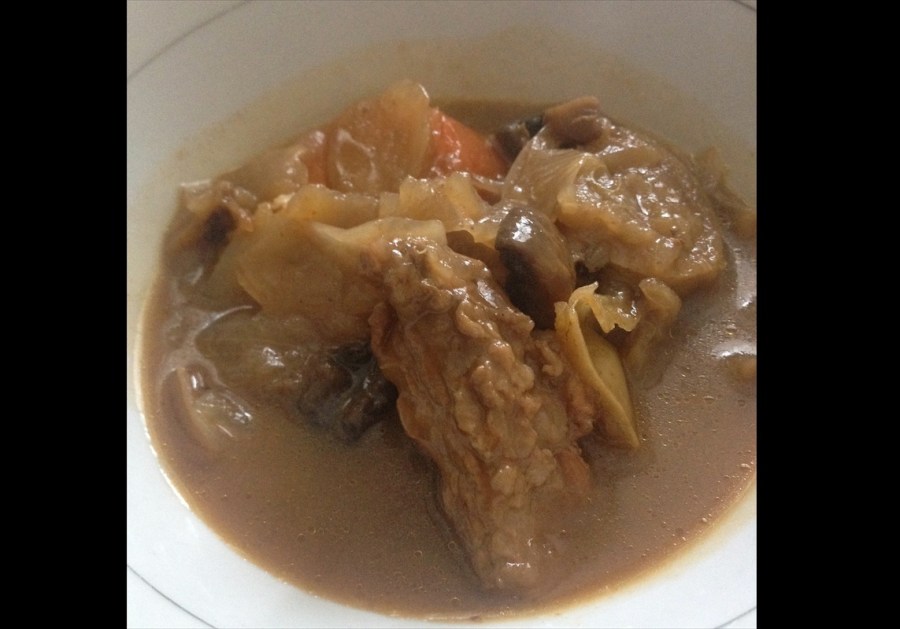
Sauté chunks of braising steak (best ones are those with fat on it), chopped onions and whole garlic cloves in LOTS of butter until browned. Add in button mushrooms, carrot chunks and a large apple (or four small ones). Add more butter, homemade stock, one tablespoon of tomato puree and half a bottle of red wine. Throw in a bay leaf, bring to boil and transfer into a slow cooker or a rice cooker. Season to taste. Cook until the meat melts in your mouth (it could take hours, but that’s it about slow-food, not fast food).

Many years later, we returned to Paris. We could afford lunch at Fauchon by then, but we went looking instead for that sweet cafe. Sadly, it wasn’t there by then, but here’s my homage to Paris in the Nineties.