Mango sticky rice, my way!

I have never been a fan of sticky mango rice, though they are available on every street corner in Phuket, Thailand, where I live for part of the year. I found them too sickly and too sweet.

But when I was in Ho Chi Minh City and had dinner at the superb restaurant called Gao in District 3 (around the corner from a romantic live-music hangout place called Cafe Soi Ba), I had the most delicious sticky mango rice ever, namely one that is not too sweet and not sickly at all.

I came home and experimented, and here it is:

200g uncooked short-grain white rice
350ml water
250ml coconut milk
100g brown sugar (in my final recipe, I omitted that and stirred in honey when the rice is cooked)
1/2 teaspoon salt
Pandan leaves, knotted
3 mangos, peeled and sliced
1 tablespoon toasted sesame seeds or chia seeds (I also used dried marigold flowers)

Cook the rice in water and pandan leaves until all the water has been absorbed. If the rice is too hard, add more water. Mix the coconut milk with the brown sugar until dissolved. Stir the mixture into the cooked rice (in the rice cooking pot where heat is retained) and keep covered for 1 hour until all the liquid is absorbed.

Drizzle with dulce le leche (optional), topped with seeds and serve with a side of small chunks of mango. Yums!

IMG_5001.JPG

‘Book’ Street, Saigon

There is a beautiful street, the most beautiful, in Saigon between Hotel Intercontinental Asiana and the Notre Dame Cathedral that is lined with cute little bookshops and a book cafe. For a bookworm like me, it was a gem in this bustling city.

If you are ever here, it is well-worth a visit. Though most of the books are in Vietnamese, they are lovely:

In the meantime, here’s a contest to free books for the rest of your life!!! Click here.

Screen Shot 2016-10-03 at 9.12.43.png

And after a blissful late afternoon at the cafe in Book Street, may I suggest that you take a leisurely stroll to this lovely place for an early dinner?

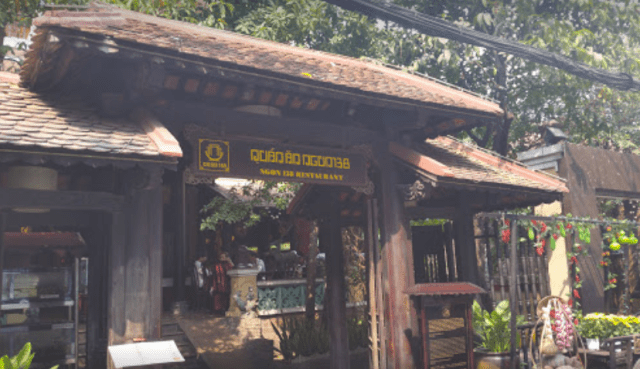
It is called Quon An Ngon 138.  It’s a beautiful, open-air colonial building that housed stalls selling local fare. You can even watch the chefs cooking it for you!

Screen Shot 2016-11-03 at 16.19.21.png

The address is: 138 Nam Kỳ Khởi Nghĩa, Bến Nghé, Hồ Chí Minh, Bến Nghé.

And for a romantic finish to your idyllic day, do pop into Cafe Soi Bar for some mellow live music. No children allowed!

Have a good stay ❤


Teaching Children Adult Love: The Six Tenets

We are more likely to teach our children about sex – especially the morality of it – that we often forget the much more important lesson in Adult Love, namely teaching them how to be in a loving adult relationship.

Whilst it is accurate to say (based on numerous scientific research) that children model their childhood home environment in their adult lives, they are also bombarded with media ideals and mixed messages from the external world.

By and large, we get by. We learn from our experiences as we go through life (perhaps that is why first loves and teenage affairs are often such dramas). We make mistakes in our early relationships, break hearts, get ours broken, and move on to the next one. That is how life goes in the modern world.

The caveat is of course if we do not learn and we end up in the same ‘wrong movie’ scenario of destructive, temporary relationships: those we love have such powers to damage us, and having been hurt, we go on damaging others, lost in the mire.

I am a strong believer in teaching children how to be someone’s spouse and parent. These are my six tenets:

  1. Be fearless

When you choose to be with someone, give yourself fully. Burn all your bridges behind you so that you can focus all your energy into your joint future.

Give children a safe childhood home that they can always come home to so that they are not afraid to be fearless.

  1. Give generously

This is not about material things, but the giving of something most precious: yourself. Do not be stingy with your love, your caresses and your kisses. Intimacy – physical and emotional – is the lifeblood of a lifelong relationship.

Be generous with your affections with your children.

  1. Focus inwards instead of running away/looking elsewhere

Being strong in times of adversity (or boredom) is the key to Forever-Love. Life cannot be on a high all the time, and having the strength to keep going is so important. As I often write: love is not an emotion, it is a construction.

Teach children to stick to something instead of giving up easily.

  1. Respect yourself and respect your spouse

Respecting your spouse means that your loyalty lies with him/her, rather than outside forces, including families and friends. This is because outside forces can be destructive to a relationship (for example, a twisted, poisonous aunt or cousin), and often, in the name of your best interest, actually cause more harm to an otherwise good relationship.

Teach children that loyalty starts in the home and never talk bad about people.

  1. Never destabilise the home

A home should always be a safe place for both parties in a relationship and their children. It is a construction and an expression of lifelong love. It is also a source of comfort and joy. If you destroy it, what do you have left? Careers and high octane sex does not last a lifetime, but a stable home does.

Teach children to value the home and the people who live within it above all.

  1. Think in terms of ‘us’ instead of I, me, mine

We are taught to be independent and self-sufficient. They both are good traits to have, but they must never obscure us to opening ourselves up to love. Life is so much more beautiful if we have someone we can truly share it with. 1 + 1 = ∞

Build close relationships in the first family so that it becomes normal for a child in his/her adult years to be sensitive to others.

******

As parents, even in this modern day and age, we dream that our children will grow up to have families of their own and living happily ever after within this nurturing framework. This natural wish is corroborated by well-known, long-term research by Harvard University and other credible institutions showing that they key to a happy life is having a good spouse.

Teaching our children about Adult-Love is our contribution as parents towards creating a pool of good spouses who will bring love, light and kindness to the lives of others. For if we don’t, who will raise our children’s good spouses?

You are never alone in your dark hours if you have someone decent and true to share your life with. Cherish that person who ends your solitary confinement. Love him / her to your best ability ❤

This article and drawing are dedicated to Anneke, who died 36 years ago when her son was eight years old.

IMG_4931.JPG

Wonderland: Shapes & Illnesses

IMG_4917.jpg

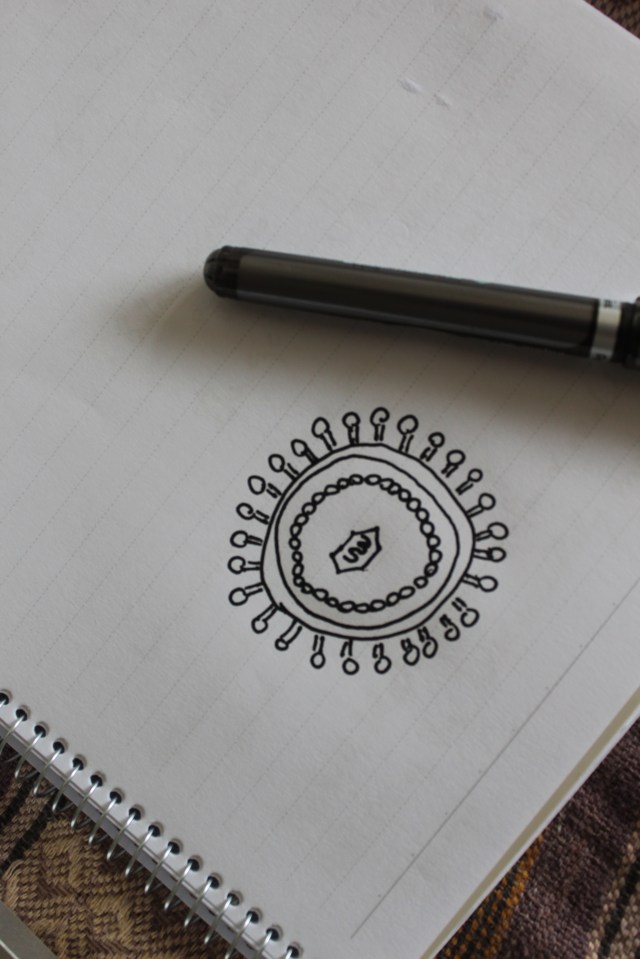
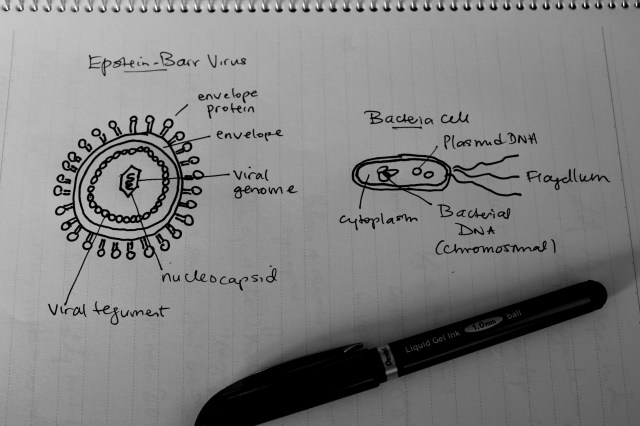
At first glance, you might think that this drawing is that of a mandala or some mathematical shape which I am so fond of. But actually, it is a diagrammatic representation of the Barr-Epstein virus.

Virus symmetry is one of the most beautiful, naturally occurring structures of nature. Though incredibly tiny (the smallest animal virus is the one that causes foot-and-mouth disease at 20nm), viron symmetry is highly structured and falls into highly organised categories: helical, polyhedral (cubical) and binal symmetry.

Not so bacterium structures which sometimes look like primitive spaceship.

IMG_4918.JPG

My daughter who is studying Biology for her International Baccalaureate commented dourly that there is so much stuff to learn for this subject. I don’t want her to just memorise stuff, but to be excited by the knowledge (or else the three years of preclinical medical course would be hellishly long for her).

So relating virus and bacteria to us and our daily lives:

Virus and bacteria cause infection in the body. When their presence is detected, the body switches on its inflammatory response, which is its strategy for fighting infection. However, inflammation can kill, though it was meant to be our body’s lifesaving strategy.

But here’s the useful piece of information that you might not previously know: virus and bacteria cause different types of inflammatory responses. Studies done at Yale University by Ruslan Medzhitov showed that a body recovering from colds (often caused by viruses) benefit from feeding, whilst those suffering from fever (typically caused by bacteria) should be starved, especially of carbohydrates which breaks down into glucose. For me, this is a really exciting discovery because it means that Medicine can move forward from blanket prescription of antibiotics – which does not work in many cases anyway – to a wellbeing system of managing health through nutrition.
The old adage of feeding the cold and starving the fever seems to be on its way to be proven ‘true’ by modern scientific establishment.

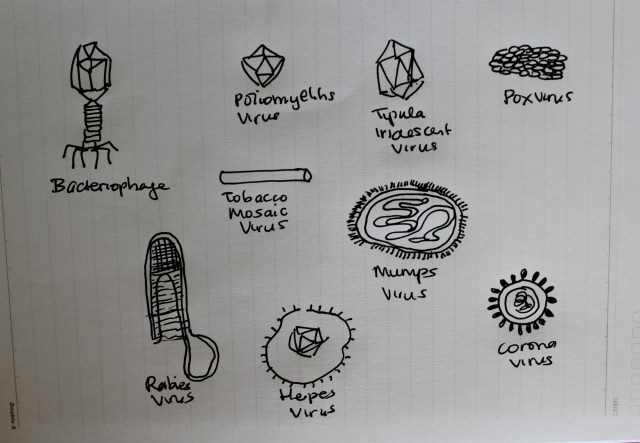
In the meantime, I leave you with some viruses.

IMG_4928.JPG

Note: In my novella which will be published on the 21st November 2016, An Evening in Wonderland – A Brief Story of Maths, Physics & The Universe (suitable for young adults), the protagonist Alice Liddell urged her beloved Professor to close his eyes and look for the symmetries in the world within and also out there in the universe, for within the shapes lie the truth that he was seeking.

You can read an interview with Ruzlan Medzhitov in the New York Times by clicking on the link here.

“Let’s talk fractals, Mum!”

When my youngest child G was in primary school, the walls outside her classroom were display boards for pupils’ artwork. She wasn’t academic at that time (being a late reader), but with child-like enthusiasm and exuberance, she used to put a lot of work into art.

Yet somehow, her creations never quite made the grade compared to her peers’. A few pupils in her class were producing such amazing work that G’s efforts looked as if they had been done blindfolded and upside down, though G consistently scored higher than these pupils in classroom-based tests and exams.

Hmmm.

My hunch was proven when she was in Year Six. Her homework was to make a volcano. She built a very realistic-looking one out of cardboard cartons filched from coffee shops, which she soaked and moulded into a volcano before spending hours painting it. It took her hours! Proudly, she had trotted off to school with her creation.

But she was somewhat deflated when she saw her classmates’ productions: fibre glass, LED, computer-printed labels, and very professional-looking. It was very obvious that these were the work of adults. I was annoyed. I wanted to complain to the school about the pervasive issue of parents and tuition teachers doing their children’s homework, but G’s father had wisely told me, “It is not important, because there will come a time when ALL kids will be graded according to their own abilities.”

Six years later, he is proven right. G is now in the first year of her International Baccalaureate programme. One of the questions under the Theory Of Knowledge box for Mathematics was, ‘How many times does something have to be repeated before it becomes a pattern?’

The physicist in me, with the benefit of three years of postgraduate studies at Oxford, jumped in enthusiastically.  Non-Euclidean vs Euclidean shapes! Supersymmetry in Theoretical Physics! Fibonacci’s Sequence!

I would gladly answer that question for her, and do a good job, too.

But my child, too used to doing her own homework, grinned at me in challenge. “Let’s talk fractals, Mum!”

And at that moment, I realised, wow, this sixteen-year-old can think very well for herself, so totally independent of me, and if truth must be known, I am learning from her.

Photograph and article on fractals from New Scientist can be found by clicking this link.

(Note: Special thanks to our friend Gary Macaulay, who is an inspired maths teacher, for the afternoons messing around with G folding tetrahexaflaxagons instead of sitting at the table drilling in past papers or teaching her how to pass exams with 100%.)

Screen Shot 2016-09-22 at 12.41.35.png

Related article: The Scenic Route to 100%

The price of a happy child

Two years ago, we came to Phuket for Georgina’s football trials. We stayed for the weekend and had a lovely time. On the way back to the airport on Sunday night, we stopped at this beach, Nai Thon beach. We had an early dinner in a seafront cafe and watched the sunset. We were so happy.

Screen Shot 2016-09-09 at 12.40.33.png

She is our much-loved youngest child and her passion is football. So we took the momentous decision to move countries for her. Her father gave up his well-paid job, and we moved into a simple, sunny house near the beach in Phuket.

She is such a happy, sunny child. She wakes up excited about life. Today, Friday, she has football practice after school and then she is going to a girl pal’s house for dinner after that. But chatting animatedly to us, she said she might have dinner at school first because she loves the ‘free’ food – apple pie with real cream, yum! – and the boarders order in pizza every Friday night.

“Don’t drink too much!” Her father joked. “You have football practice tomorrow morning.”

“I don’t need alcohol to be happy,” she retorted.

She is indeed a happy child, sunny all the way through. Her first years were spent in Portsmouth, less than 500 metres from her grandparents’ home. Apart from her siblings, she had cousins around her. She went to Story Time Nursery, and the principal is Mrs. Janet Josephine Storey, seen here. I don’t think they did much reading and writing, just lots of French, playing outdoors (even in winter) and being read to endlessly.

Screen Shot 2016-09-09 at 12.40.43.png

She has a gift for maths, but we did not pursue that. In school, when she should have been in the Gifted & Talented programme, she was kicking a football around in the hot sun. She could have done much better at school, but for a girl who couldn’t read until she was eight, we were happy with where she was. She couldn’t draw and she couldn’t play musical instruments, though she occasionally strums the guitar alongside her rocker dad, but that’s OK. Those afternoons were filled with her howls of laughter, curious questions and sunny energy.

She played football in the midst of exams, she went on a little holiday with us and a little party here and there too; life went on as normal. But incredibly, she sailed through her IGCSEs with a very respectable number of A’s and A*’s. Even if she hadn’t, it wouldn’t have mattered, really. Her eternal sunshine and positivity would have seen her through the darkest days and highest mountains just fine.

IMG_4136.JPG

A syllabus for REAL learning

One of the luxuries that I am most grateful for is the opportunity to be a full-time, stay-at-home mum. Some might think it’s decadent, given that my youngest child is already 16 and her older siblings (eldest one is 31) all live abroad. But apart from my time at home with my other children and my parents, the rest of my time is wholly dedicated to Georgina, as is her father’s. She is our last offspring to cap off our long parenting journey and we are savouring every moment of our time with her. We both would be in the car together as much as possible when we ferry her round, be it to football practice or her boyfriend’s house or even just to a party down the road. During the car journeys, we talk non-stop about many things. I think her “real” education happens here. Below is an example.

******

So, what do you remember about Chemistry from your own school days? Many of you would say remembering chemical reactions (what colour when you mix A with B, etc). Many of you would say equations. Many of you would say test tubes.

I had a wonderful teacher called Cliff Haskins, an Oxford man. He would tell us, “Just remember the first 15 minutes. We can talk about other things after that.” Little did I know then, but dear Mr Haskins actually worked very hard before each class to put all we need to know for a particular topic into 15 minutes of teaching time. Because we had such a sweet deal with him, we always paid rapt attention for the first 15 minutes. The other 45 minutes, well, we spent talking. Either gossiping with each other (he never minded) or taking part in his interesting, offbeat discussions.

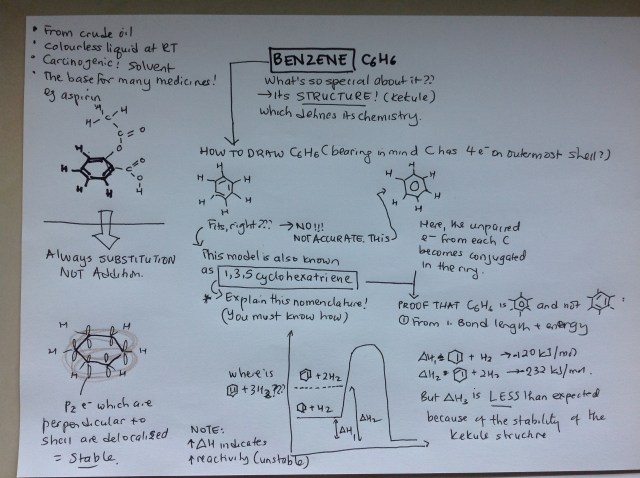
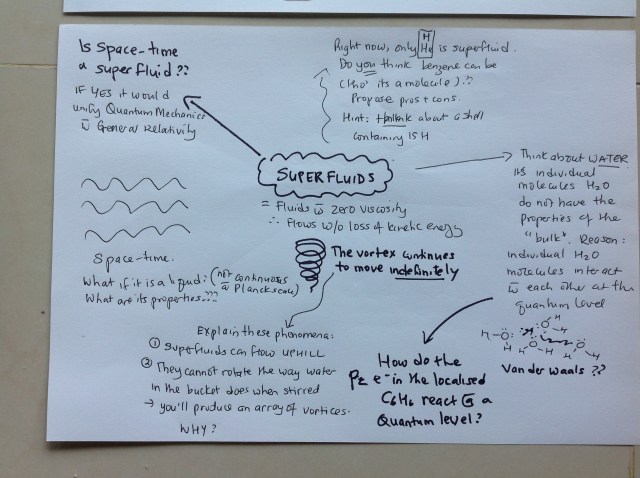
I decided to teach my child this way. She had to learn benzene in class today. but here is what I was preparing at home for us to have fun with.

Step 1: Getting excited about C6H6

What’s so special about benzene? Its structure, of course. Try drawing C6H6, taking into consideration the covalence of C and H. What did you get? Scientists couldn’t figure out what it looked like for a long time. Codswallop about dreams of snakes swallowing each other’s tails and 6 monkeys holding hands. Finally, it was proved by looking at the bond lengths and Delta H.

img_9827

Step 2: So what?

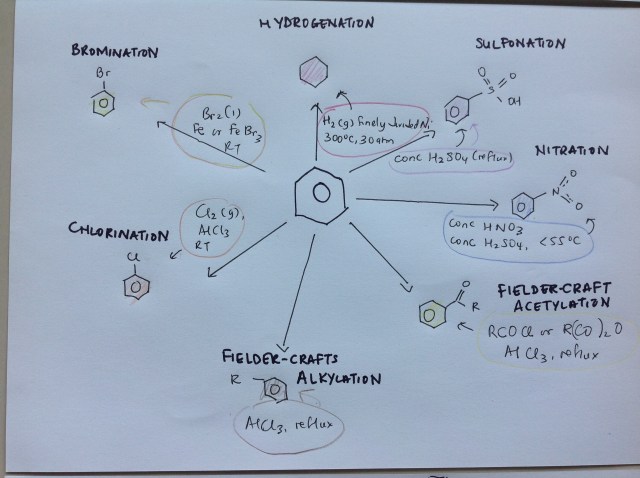
Its shape gives it its special properties. It does not undergo addition, but substitution happens quite a lot. Aspirin, paracetomol, solvents. They are all benzene-based. Sorry dear child, you have to memorise the key reactions, but I have summarised the key points for you. It’s not too bad if you print this out and stick it on your wall. Look at it before you fall asleep at night instead of your boyfriend’s photograph.

img_9828

Step 3: Let the fun begin!

In my book, Catching Infinity, I wrote that exciting things happen at the boundaries. That’s why daredevils leap off tall buildings and biplanes. But we can do the same sitting in the comfort and safety of our homes IF we allow our brains to leap into the unknown. Real education after all is about exploring and thinking the improbable, rather than memorising. So I put this to my child: think about the extraordinary properties of benzene because of its delocalised pz electron cloud. Now think about superfluids. Can benzene possibly be a candidate for superfluids? And imagine what a world with a benzene-like spacetime feel like? Would it be like Alice In Wonderland’s treacle world?

img_9829

Yes, I was wrong to criticise the International Baccalaureate syllabus. After all, she goes to school to learn the rudiments to pass exams. It is up to me, her parent, to teach her about excitement and the boundless possibilities, and I am loving the journey.

Is this worth fighting over?

IMG_7706.JPG

Back home in the UK, I am less rigid about washing up. Because unlike in Asia, there are no cockroaches, ants, rats and other scavengers waiting for your unwashed plates. Also, because of the higher temperature in Asia, any bits of unwashed food also stink to high heaven if left in the sink overnight. Our family also uses the dishwasher less in Asia because there are only three of us at home here. Dishwashing tablets are expensive in Asia.

So, after the long summer holiday…..my child begins leaving dirty things unwashed in the sink. It is often just a glass, the blender, a side plate. It takes me just a few seconds to wash a plate or a cup up. It would be very easy to do when I am washing my own stuff up.

But I yelled at her to come and wash her own stuff up. “I will! In a minute,” she answered back. “I’m doing my homework now.”

Come now and wash up your stuff in the sink, please. No compromise. Reason for my tough stance: it is a habit that I don’t want her to fall into. This is laziness. It is lack of discipline. Because the one minute or so that it takes her to wash these up builds a way of being in her which teaches her not to expect someone to clean up after her.

And it is not just down to unwashed plates and cups in the sink. It is down to life. I have known a few people who expect others to clean up after them in life. They make a mess, walk away from their mess, leaving carnage behind insouciantly because they assume that it is the duty of others to clean up after them.

Apologies for being a Tiger Mum where this is concerned, but so long as there is breath in my body, none of my children will ever have that entitlement mentality because it is an awful way to be. It is never good to use and abuse others rather than automatically elect to do our bit for the world.

In the meantime, I came across this cute photograph on the Internet. My sentiments, exactly!

Screen Shot 2016-08-25 at 11.53.23


Homemade ice lollies

I should have posted this in the beginning of summer, but truth is, I only made these ice lollies because I was having an adults’ dinner party and I was too lazy to make a dessert. And ice cream can be a hassle to make because you have to keep taking them out of the freezer to beat it up or it becomes hard like rocks.

Ice lollies are simple. You just pour juice in the moulds and freeze.The green one is lime and spinach (and other greens) whilst the creamy one is made from:

125ml almond milk

125ml light coconut milk

3tbsp agave syrup

3 tbsp chia seeds

3 tbsp desiccated coconut

A handful of strawberries

Blend the milks and the strawberries – but not to fine. I like to see the red bits.  Add in the agave, desiccated coconut and chia seeds. Leave for the chia seeds to soften (about a couple of hours). Pour into moulds and freeze.

My adult dinner party guests loved them!


Raising my girls to be strong women

I have been asked, given my traditional views on parenting, if I raised my girls to be subservient to the boys, their protectors. Do I raise my girls to know how to cook, clean and be good parents? Yes, in the same way that I raised my boys to know to cook, clean and be good parents.

But in addition, I raised my girls to honour their evolutionary biology. Our strength as women is not gained from trying to be ‘better’ than the boys and beat them at their own game. Physiologically, women are weaker. Biologically, women have periods in their lives when they are reliant on others (during pregnancy and nursing). Emotionally, women are peacemakers and homemakers to ensure the survival of our species. Why change something that had served us so well for so many millennia?

Our great strength lies in our ability to cooperate with each other. Women need to trust and work together rather than regard other women as competitors in the fight for men and top jobs.

“I am more of a man’s woman than a woman’s woman,” an Asian woman brought up in Germany once told me proudly. What does that mean? Does that mean you are more European than Asian, this ’emancipation’?

“I have no time for women,” this person told me. “I prefer the company of men. I have more in common with them.”

Oh, I see.

We gain so much more from working together, especially with other women. Our biology supports that. In the periods when you need to rely on others, that others do not have to be a man. It can be other women who form your protective blanket. When I was gravely ill, apart from my male partner, my strongest supports were three amazing women.

You might denounce this article as amateur psychology, but just look at the success of Grameen Bank founded by Mohammed Yunus that concentrates the bank’s microcredit efforts on women. Women work so beautifully together.

And thus, I raised my daughters to be great friends with each other first and foremost, to learn this basic quality that makes us stronger than tempered steel IF we honour our difference. This is truly our real strength, the inane ability to build and grow together.

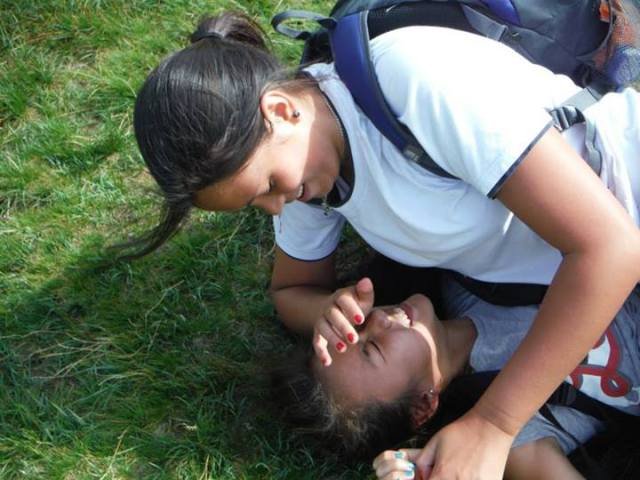
Back to my daughters. There are nine years and a son between my two daughters. Their lives together started with Kat, the older one, nurturing and caring for baby sister G. Kat was like a little mother hen and a fierce lioness all at once, protecting her young. She was so proud and defensive of her younger sister.

IMG_4463.jpg

But over the years, that role slowly evolved. Though still very much the respected one, Kat was relaxing her strictness towards her little sister bit by bit. They began doing things together like shopping for clothes and going to parties, though they are very different as individuals. They began having secrets with each other than no one else was privy to. And slowly, they became equals of sorts, evolving from mentor/protege to confidantes. You couldn’t find two young women who are closer friends, and that is indeed truly lovely to see.

IMG_4355.JPG