The price of a happy child

Two years ago, we came to Phuket for Georgina’s football trials. We stayed for the weekend and had a lovely time. On the way back to the airport on Sunday night, we stopped at this beach, Nai Thon beach. We had an early dinner in a seafront cafe and watched the sunset. We were so happy.
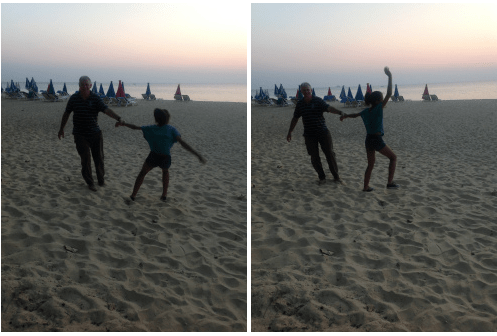
Screen Shot 2016-09-09 at 12.40.33.png

She is our much-loved youngest child and her passion is football. So we took the momentous decision to move countries for her. Her father gave up his well-paid job, and we moved into a simple, sunny house near the beach in Phuket.

She is such a happy, sunny child. She wakes up excited about life. Today, Friday, she has football practice after school and then she is going to a girl pal’s house for dinner after that. But chatting animatedly to us, she said she might have dinner at school first because she loves the ‘free’ food – apple pie with real cream, yum! – and the boarders order in pizza every Friday night.

“Don’t drink too much!” Her father joked. “You have football practice tomorrow morning.”

“I don’t need alcohol to be happy,” she retorted.

She is indeed a happy child, sunny all the way through. Her first years were spent in Portsmouth, less than 500 metres from her grandparents’ home. Apart from her siblings, she had cousins around her. She went to Story Time Nursery, and the principal is Mrs. Janet Josephine Storey, seen here. I don’t think they did much reading and writing, just lots of French, playing outdoors (even in winter) and being read to endlessly.

Screen Shot 2016-09-09 at 12.40.43.png

She has a gift for maths, but we did not pursue that. In school, when she should have been in the Gifted & Talented programme, she was kicking a football around in the hot sun. She could have done much better at school, but for a girl who couldn’t read until she was eight, we were happy with where she was. She couldn’t draw and she couldn’t play musical instruments, though she occasionally strums the guitar alongside her rocker dad, but that’s OK. Those afternoons were filled with her howls of laughter, curious questions and sunny energy.

She played football in the midst of exams, she went on a little holiday with us and a little party here and there too; life went on as normal. But incredibly, she sailed through her IGCSEs with a very respectable number of A’s and A*’s. Even if she hadn’t, it wouldn’t have mattered, really. Her eternal sunshine and positivity would have seen her through the darkest days and highest mountains just fine.
IMG_4136.JPG

A syllabus for REAL learning

One of the luxuries that I am most grateful for is the opportunity to be a full-time, stay-at-home mum. Some might think it’s decadent, given that my youngest child is already 16 and her older siblings (eldest one is 31) all live abroad. But apart from my time at home with my other children and my parents, the rest of my time is wholly dedicated to Georgina, as is her father’s. She is our last offspring to cap off our long parenting journey and we are savouring every moment of our time with her. We both would be in the car together as much as possible when we ferry her round, be it to football practice or her boyfriend’s house or even just to a party down the road. During the car journeys, we talk non-stop about many things. I think her “real” education happens here. Below is an example.

******

So, what do you remember about Chemistry from your own school days? Many of you would say remembering chemical reactions (what colour when you mix A with B, etc). Many of you would say equations. Many of you would say test tubes.

I had a wonderful teacher called Cliff Haskins, an Oxford man. He would tell us, “Just remember the first 15 minutes. We can talk about other things after that.” Little did I know then, but dear Mr Haskins actually worked very hard before each class to put all we need to know for a particular topic into 15 minutes of teaching time. Because we had such a sweet deal with him, we always paid rapt attention for the first 15 minutes. The other 45 minutes, well, we spent talking. Either gossiping with each other (he never minded) or taking part in his interesting, offbeat discussions.

I decided to teach my child this way. She had to learn benzene in class today. but here is what I was preparing at home for us to have fun with.

Step 1: Getting excited about C6H6

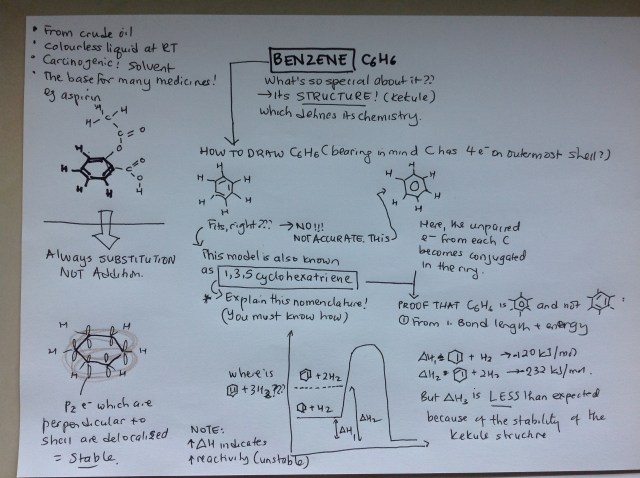
What’s so special about benzene? Its structure, of course. Try drawing C6H6, taking into consideration the covalence of C and H. What did you get? Scientists couldn’t figure out what it looked like for a long time. Codswallop about dreams of snakes swallowing each other’s tails and 6 monkeys holding hands. Finally, it was proved by looking at the bond lengths and Delta H.

img_9827

Step 2: So what?

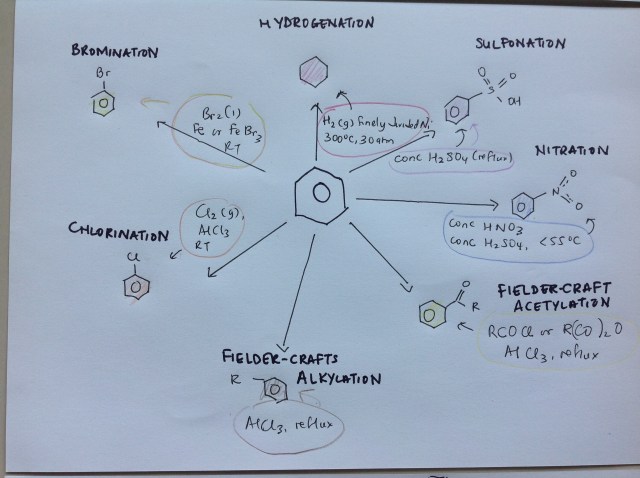
Its shape gives it its special properties. It does not undergo addition, but substitution happens quite a lot. Aspirin, paracetomol, solvents. They are all benzene-based. Sorry dear child, you have to memorise the key reactions, but I have summarised the key points for you. It’s not too bad if you print this out and stick it on your wall. Look at it before you fall asleep at night instead of your boyfriend’s photograph.

img_9828

Step 3: Let the fun begin!

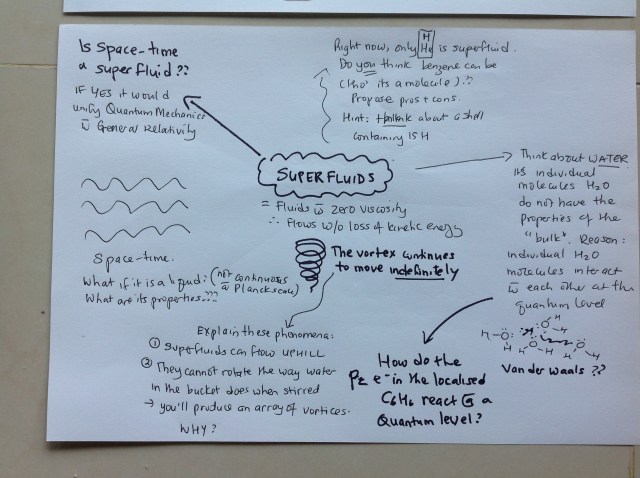
In my book, Catching Infinity, I wrote that exciting things happen at the boundaries. That’s why daredevils leap off tall buildings and biplanes. But we can do the same sitting in the comfort and safety of our homes IF we allow our brains to leap into the unknown. Real education after all is about exploring and thinking the improbable, rather than memorising. So I put this to my child: think about the extraordinary properties of benzene because of its delocalised pz electron cloud. Now think about superfluids. Can benzene possibly be a candidate for superfluids? And imagine what a world with a benzene-like spacetime feel like? Would it be like Alice In Wonderland’s treacle world?

img_9829

Yes, I was wrong to criticise the International Baccalaureate syllabus. After all, she goes to school to learn the rudiments to pass exams. It is up to me, her parent, to teach her about excitement and the boundless possibilities, and I am loving the journey.

Chicken Chasseur

FullSizeRender-67.jpg

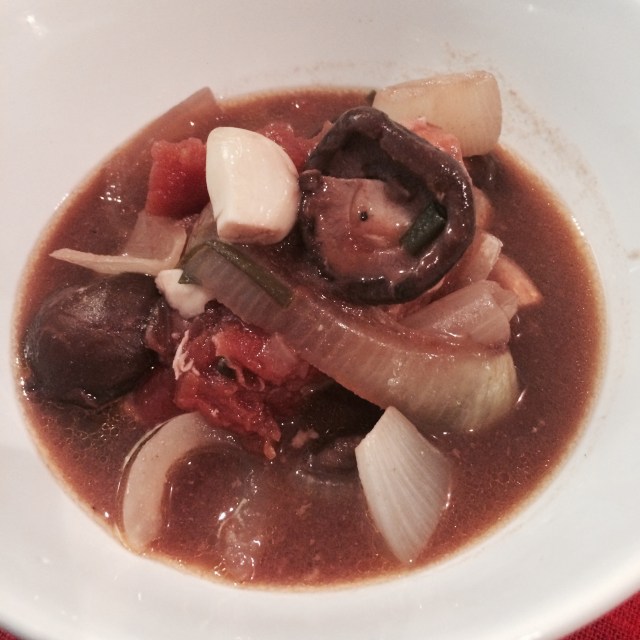
A long time ago, I came across a tiny little restaurant in the backstreet of Paris. This simple restaurant, frequented by the lunchtime office crowd, served the most heavenly chasseur on a small coccote with a stick of baguette. Ever since then, I have been trying to get my chasseur to that standard. Here’s the closest I got to:

Butter
Shallots or half a sliced Spanish onion (former is better) 3 cloves whole garlic Button mushrooms
1 tsp. tomato puree
A generous shot of brandy
2 ripe red tomatoes
Ladle of fresh chicken stock
4 tbsp. double cream
Sea salt and freshly ground black pepper

Brown the chicken and set aside.

Saute the shallot/onion until soft. Return chicken to the pan. Add the mushrooms and tomato puree. Add the brandy and flambé it. Add the tomatoes and chicken stock. Reduce to a third. Add the cream, and season to taste. Allow to simmer for 5 minutes, ensuring that the sauce is kept thick and consistent, but not burnt or dry.

Serve with fresh baguette, or if you are feeling decadent, make garlic bread to go with it.

Is this worth fighting over?

IMG_7706.JPG

Back home in the UK, I am less rigid about washing up. Because unlike in Asia, there are no cockroaches, ants, rats and other scavengers waiting for your unwashed plates. Also, because of the higher temperature in Asia, any bits of unwashed food also stink to high heaven if left in the sink overnight. Our family also uses the dishwasher less in Asia because there are only three of us at home here. Dishwashing tablets are expensive in Asia.

So, after the long summer holiday…..my child begins leaving dirty things unwashed in the sink. It is often just a glass, the blender, a side plate. It takes me just a few seconds to wash a plate or a cup up. It would be very easy to do when I am washing my own stuff up.

But I yelled at her to come and wash her own stuff up. “I will! In a minute,” she answered back. “I’m doing my homework now.”

Come now and wash up your stuff in the sink, please. No compromise. Reason for my tough stance: it is a habit that I don’t want her to fall into. This is laziness. It is lack of discipline. Because the one minute or so that it takes her to wash these up builds a way of being in her which teaches her not to expect someone to clean up after her.

And it is not just down to unwashed plates and cups in the sink. It is down to life. I have known a few people who expect others to clean up after them in life. They make a mess, walk away from their mess, leaving carnage behind insouciantly because they assume that it is the duty of others to clean up after them.

Apologies for being a Tiger Mum where this is concerned, but so long as there is breath in my body, none of my children will ever have that entitlement mentality because it is an awful way to be. It is never good to use and abuse others rather than automatically elect to do our bit for the world.

In the meantime, I came across this cute photograph on the Internet. My sentiments, exactly!

Screen Shot 2016-08-25 at 11.53.23


Homemade ice lollies

I should have posted this in the beginning of summer, but truth is, I only made these ice lollies because I was having an adults’ dinner party and I was too lazy to make a dessert. And ice cream can be a hassle to make because you have to keep taking them out of the freezer to beat it up or it becomes hard like rocks.

Ice lollies are simple. You just pour juice in the moulds and freeze.The green one is lime and spinach (and other greens) whilst the creamy one is made from:

125ml almond milk

125ml light coconut milk

3tbsp agave syrup

3 tbsp chia seeds

3 tbsp desiccated coconut

A handful of strawberries

Blend the milks and the strawberries – but not to fine. I like to see the red bits.  Add in the agave, desiccated coconut and chia seeds. Leave for the chia seeds to soften (about a couple of hours). Pour into moulds and freeze.

My adult dinner party guests loved them!


Raising my girls to be strong women

I have been asked, given my traditional views on parenting, if I raised my girls to be subservient to the boys, their protectors. Do I raise my girls to know how to cook, clean and be good parents? Yes, in the same way that I raised my boys to know to cook, clean and be good parents.

But in addition, I raised my girls to honour their evolutionary biology. Our strength as women is not gained from trying to be ‘better’ than the boys and beat them at their own game. Physiologically, women are weaker. Biologically, women have periods in their lives when they are reliant on others (during pregnancy and nursing). Emotionally, women are peacemakers and homemakers to ensure the survival of our species. Why change something that had served us so well for so many millennia?

Our great strength lies in our ability to cooperate with each other. Women need to trust and work together rather than regard other women as competitors in the fight for men and top jobs.

“I am more of a man’s woman than a woman’s woman,” an Asian woman brought up in Germany once told me proudly. What does that mean? Does that mean you are more European than Asian, this ’emancipation’?

“I have no time for women,” this person told me. “I prefer the company of men. I have more in common with them.”

Oh, I see.

We gain so much more from working together, especially with other women. Our biology supports that. In the periods when you need to rely on others, that others do not have to be a man. It can be other women who form your protective blanket. When I was gravely ill, apart from my male partner, my strongest supports were three amazing women.

You might denounce this article as amateur psychology, but just look at the success of Grameen Bank founded by Mohammed Yunus that concentrates the bank’s microcredit efforts on women. Women work so beautifully together.

And thus, I raised my daughters to be great friends with each other first and foremost, to learn this basic quality that makes us stronger than tempered steel IF we honour our difference. This is truly our real strength, the inane ability to build and grow together.

Back to my daughters. There are nine years and a son between my two daughters. Their lives together started with Kat, the older one, nurturing and caring for baby sister G. Kat was like a little mother hen and a fierce lioness all at once, protecting her young. She was so proud and defensive of her younger sister.

IMG_4463.jpg

But over the years, that role slowly evolved. Though still very much the respected one, Kat was relaxing her strictness towards her little sister bit by bit. They began doing things together like shopping for clothes and going to parties, though they are very different as individuals. They began having secrets with each other than no one else was privy to. And slowly, they became equals of sorts, evolving from mentor/protege to confidantes. You couldn’t find two young women who are closer friends, and that is indeed truly lovely to see.

IMG_4355.JPG

World Wide Web

The Internet is so pervasive in our lives, but do you ever stop to wonder about a greater, more magical network, one that is created entirely Nature?

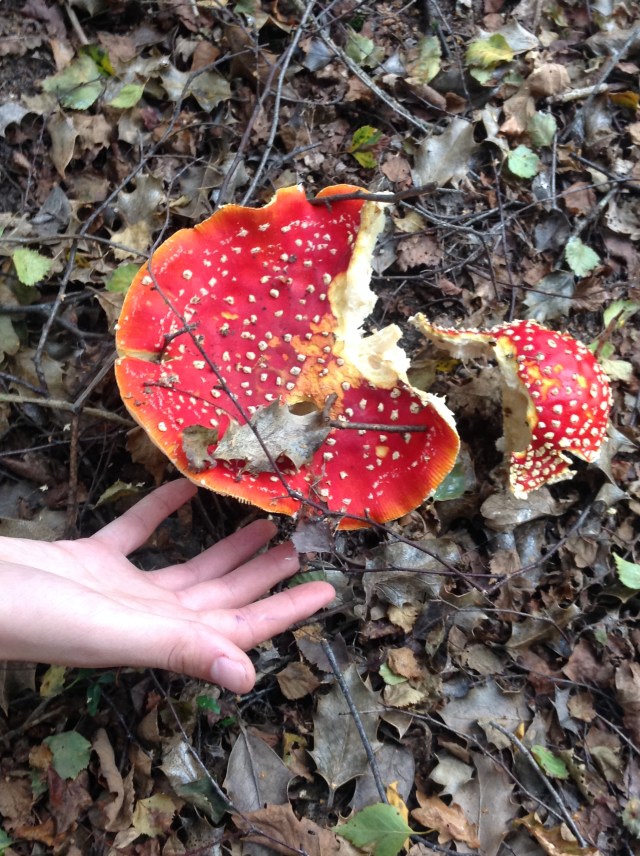
My parents are both passionate biologists, and they created that wonder in me that never dims. Their particular passion is fungi. Mushrooms to you and I. But what we see above ground are just the sex organs of these small but amazing organisms. Beneath these fungus are roots that nurture the whole forest through a beautiful mutualistic symbiotic relationship. A complexity far beyond the comprehension of the mere human brain exists below ground, connecting all living things. Indeed, the forest is far more than you can see.

So here’s a little practice in mindfulness: the next time to log on to the Internet, think about the magical network beneath your feet.

https://www.ted.com/talks/suzanne_simard_how_trees_talk_to_each_other?language=en#t-635181

Working on my next book, inspired by my parents, of course ❤

IMG_8835

Understanding the physical world

In conversations with my daughter, I became interested in how we learn maths (because my novel is maths/physics-based). She has many friends who does not understand maths, cannot do maths and are scared of maths. Unfortunately that fear and dislike persists till adulthood, possibly for the rest of someone’s lifetime. I hope my Catching Infinity will change that.

There are sociological theories about why maths holds terror for many students: thinking in abstract and in symbols is not ‘normal’ in the world we live in, and also the fact that it is a subject that a student is either right or wrong. Fear of failure often impedes progress in the subject. You have to be relaxed to be good at maths.

Yet maths is the foundations of so many things. Like physics.

Here’s something that came to my attention recently:

One thing that never fails to awe me is the fact that so much of the human brain is unknown despite the billions we have invested into its research. For example, do you know that there is a special part of the human brain that is responsible for comprehension of physics/physics-like subjects? Take away the maths and the scary equations, physics is just an inner intuitive sense for how things will bounce, wobble, or fall. We use it all the time unconsciously in our heads. So, my message to adults and children alike, learn to love physics.

To test the physics centre of your brain, go to:

Six ways of managing teenage rebellion

I get absolutely no sympathy from my mother whenever I complained about her grandchildren. She would remind me with a smug grin that I was even worse. “You were a hundred times worse, Jac,” she would say cheerily.

Which leads me to think, teenage rebellion is a rite of passage. Children become teenagers before they become adults, and thus, the teenage years are a staging post where they push the boundaries and explore who they really are (rather than extensions of their parents). When teenagers rebel against your house rules, they are testing how far they can go and what they can get away with. Clamp them down too much and they fail to develop their own personalities. Give them too much liberty and they become unlikeable, obnoxious adults.

My feisty and headstrong sixteen year old G who has strong views on everything is surprisingly easy to deal with. For someone who claims to run her own life, she is surprisingly compliant with our house rules. For example, a few months ago, her whole year group was going out to the notorious party town of Patong to celebrate the end of the year-end exams. Our curfew was midnight. “But the party hardly starts then,” she protested half-heartedly. True. They were meeting up at 11pm. Her friend’s mother offered to accompany the girls and took out a hotel room in the middle of town. G asked if she could stay over. No. Of course. “Why?” She demanded. “I just want to know.”

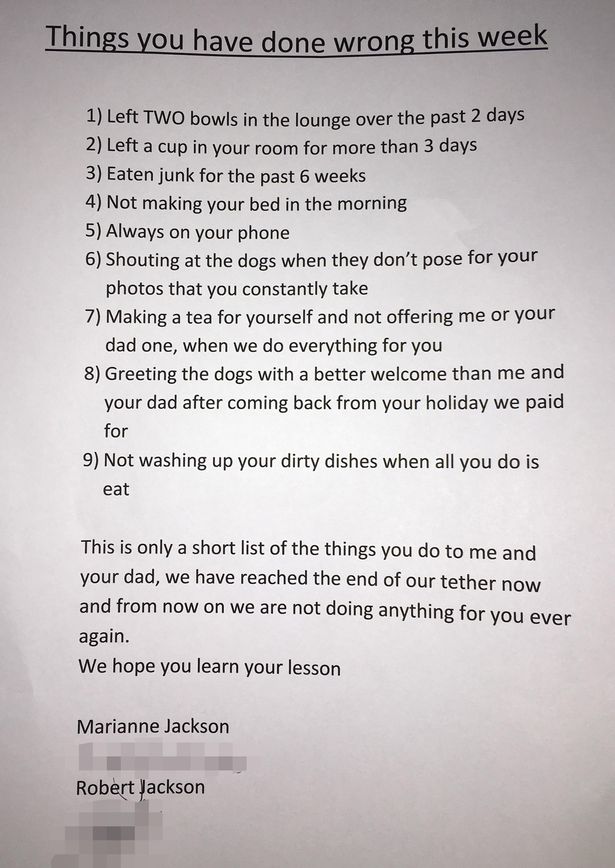
And really, that was the end of our unpleasantness. I think a lot of it is down to establishing good communication between you and your teen. Recently, a mother issued her daughter ‘rap sheet’ which the daughter posted online and it went viral:

PAY-List-of-things-that-Nicola-had-been-doing-wrong

You can read the story here.

These are my six tried and tested strategies of coping with teenage rebellion:

  • It starts long before then. It starts when your children were small enough to listen unquestioningly to your words. That is when you lay down the foundations of how your home is run and how your family life is lived. And what you find acceptable or not acceptable. For me, rudeness is never acceptable, so even when we are disagreeing, everyone must do so with respect for each other.


  • Build a good communication platform. Talk often to your teenagers. Show them that you are a good guy who sometimes have to play bad cop because that’s your job as a parent.


  • Don’t have too many rules. Have a few key ones that are non-negotiable. This means that you don’t exhaust yourself and use up your merits over inconsequential battles.


  • When rules need to be broken, come to a reasonable agreement. Because as parents, don’t be too arrogant about learning, too. It is never that simple and nor is parenting black-and-white. Be prepared to discuss and negotiate.


  • Don’t expect to solve everything with one conversation. Be prepared to park the matter and return to it later.


  • Do your best to create a happy family home (and that means you yourself being happy too). A happy teenager would be more likely to cooperate with you.

Screen Shot 2016-08-01 at 20.54.59

A way of living

When my children were young, we had lots of picnic. We almost never left the house without a picnic basket for a very simple reason: we didn’t have that much money, and even tea and cake in a cafe cost a lot when there were so many of us. So we never ate out. We ate lots of cheese sandwiches on fields, in parks, grasslands, meadows, forests and seafronts all over England and Europe. We picnicked on beautiful sunny days but we have also picnicked under grey, drizzling skies, sitting on horse blankets, eating soggy cheese sandwiches.

Whenever I was too lazy or too rushed, I’d just buy stuff from the delicatessen or supermarket and make up an impromptu picnic.

Apart from the cost-savings, the upside we found was the fact the kids never whined about being ‘hungry’ whenever the saw or smell yummy stuff. They never pestered us for candy floss or burgers. Because they know my response: “Let’s see what’s in the picnic basket if you’re hungry.”

So now, the kids are grown. We can afford to eat in cafes and restaurants on our trips. But old habits die hard….it has indeed become a way of living, something that I really cherish. That’s us today, bumping along on the country roads with a picnic basket and horse blankets in the backseat.

IMG_4450.JPG