Love letter to my Mother-in-Law

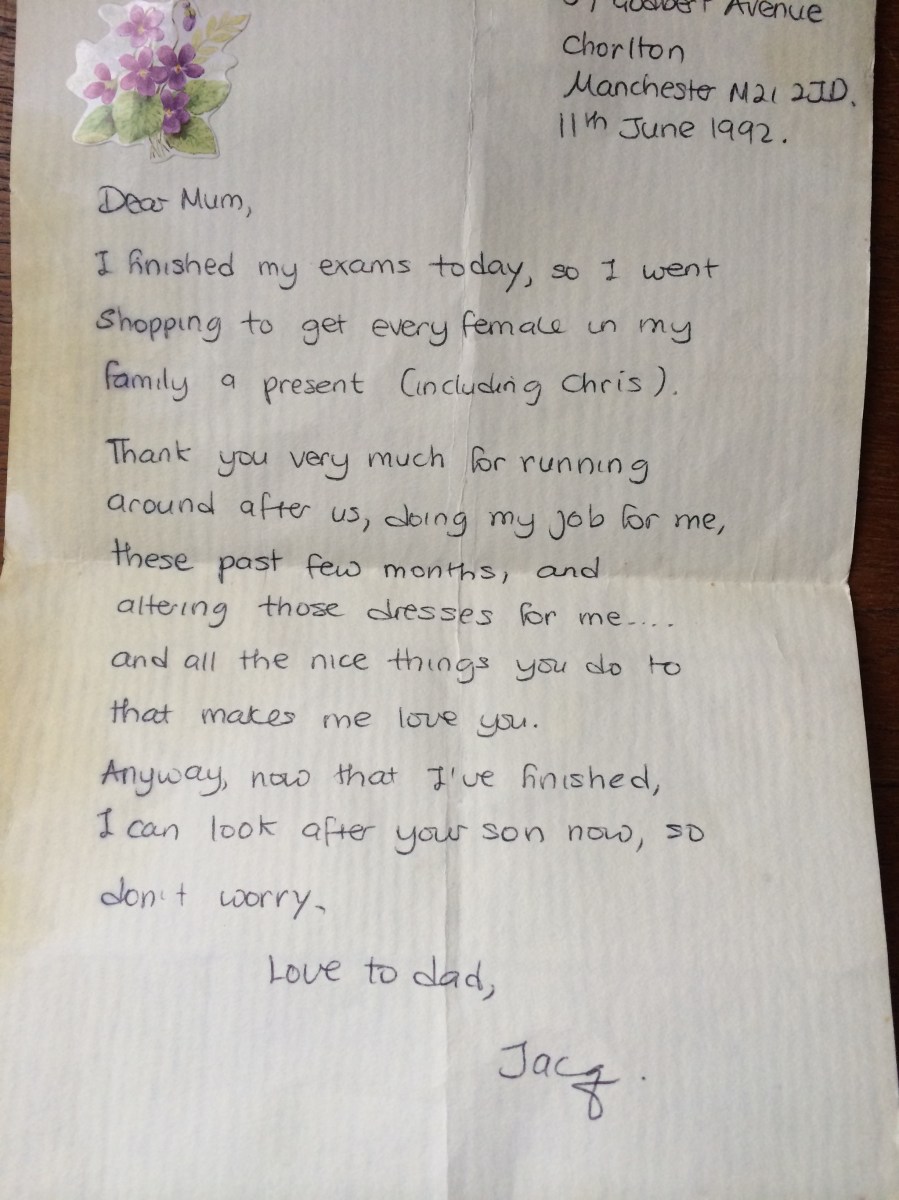
I finished my University final exams on 11th June, 1992. I was no more than a child, still an inner void within me to fill, but I was already a mother to four children who went to University with me and grew up together with me.

It would not have been possible without my mother, who was always just a telephone call and a 3-hour car-drive away. My mother was always there to comfort and cosset. She never criticised, she just loved me unconditionally.

My mother-in-law was different from my mother. She was not as tolerant as my own mother. The summer the children and I had to live in her house whilst saving up for a deposit for our first home was a torture for me. I was expected to work, as opposed to being treated like a princess whenever I was at my parents’ house. Whenever I was in my parents’ house, my mother took over everything so that I could have my much-needed rest from my studies and from being a mother to a large brood.

My mother-in-law cured me of my spoilt behaviour, but it was a baptism of fire. I was lazy and incapable, and her son deserved more than the teenager who was dumb enough to fall pregnant on the first date, and who wanted grand things in life rather than knuckling down to being a mother, taking care of the family the proper way. I should have been thankful for the things I had, instead of chasing silly dreams at the expense of the family.

I used to run back to my mother, crying.

She, my mother, would tell me to learn to love my mother-in-law instead of commiserating with me.

“She’s your mother now,” my mum said, though her heart must have been bleeding at my tears.

And yes she was. My mother-in-law was my mother now. She made my maternity dresses. She was up at 3am with my colicky baby. She took the time to sit in the garden with me in her busy day. She tried to understand me.

Slowly, we began to laugh together. What started as an argument between us would end up in laughter. We began to cherish magical moments together, like sitting with a three week old baby in the rain eating soggy cheese sandwiches, because she was adamant that children need lots of fresh air (even in the rain). Slowly, the enmity turned into a deep and abiding love. It wasn’t an easy relationship, but nonetheless it was one that shaped my life.

This summer, I cut flowers from her garden to bring to her in her nursing home. I found this letter, and it brought it back to me, the love I have for my two mothers, two amazing women, whom I owe everything to. They are still my mothers, and I their daughter, though I am 47 with a string of qualifications, impressive work experience, financial independence and five grown-up children. This positive dependency was brought into sharp focus this summer: though my mother-in-law is no longer capable of looking after herself, I still run to her, as I did this summer, when I needed a home.

Packing for Life’s Journey

One thing you learn if you are a mother with many small children living in an expensive city like London: you always carry food and drinks in your bag even if it is for a short trip out. Last summer, though my youngest child is already 15 and we have sufficient money in the bank for the odd cup of tea and the odd packet of sandwiches, I still could not stop myself carrying food and drinks in my very uncool big handbag.

At church yesterday, it was a young Filipino priest who gave the homily. He said that in his culture, food for travelling is a big deal. And he asks, what do we carry in our hearts for the journey of life: all the good things like love, compassion, mercy, wisdom, hope…..or heaviness such as bitterness, anger, regret?

It struck a chord deep in me.

Many years ago, whilst I was teaching yoga in NYC, I had a young lady in my class. Her body was tight, tense. She never looked like she was enjoying my class. I largely ignored her, believing that people come to yoga to find their quiet space.

One day, she came to me after class and said “Thank you” for something I said during class. We were doing inversions, and I trotted out the usual yoga teacher dialogue: “Look at the world differently and let go of the rocks in your heart so that you are light enough to stand on your hands. Lose your fear and all the heavy stuff.”

Her story came tumbling out. She was abused as a child, and for 20 years, she had carried hatred for that person in her heart and it stopped her moving on. Inside the grown woman was a child stunted by hatred.

So she decided to try to let go, and fill her life with light things. I like the visualisation of starting today with an empty bag, and going through the day filling the bag up with goodness. The good stuff for life’s journey – big smile 🙂

Education for Tomorrow

People are often confused about my education philosophies.  My children’s father and I are both unapologetic beach bums living on the paradise island of Phuket, with no ambition beyond walking the beach each day. Our older children have all grown and flown the nest, back to our home country (UK) and making strides in their adult lives. Now, there is only Georgina left. She is our last child, and her father and I are living the last years of our parenting journey with her (or should I say, through her).

We both have seen a lot, as one does with over a decade of travelling, living in foreign lands, meeting unusual people and raising five kids. Oh, the wisdom we have acquired from the road, it is nothing like what the books tell you. Of course, as parents, we want to impart the real-life wisdom to her – after all, what parents don’t.

A couple of the important things that we have learned: happiness is internal (therefore don’t go chasing big job titles) and in a world that has become increasingly fast-paced, we have to hold on to good old-fashioned values. And thus, we tell our child, you get the best learning at home (well, on the beach) and in church.

But here’s our dilemma – we have a child who is gifted (I hate the word) and who storms ahead, propelled by her curiosity of the world around her, her impatience at not knowing answers, and her desire to rule the world and see her name in lights.

With the benefit of hindsight, experience and years on the road, we want to tell her this:  a lot of what you obsess about is not important, anymore than exam grades are.

Fortunately, we live on a holiday island and she attends a progressive British international school, so the focus on exams is missing from her psyche. Thank goodness.  I could not have coped with exam stress for the second time in my life (coping with my own was bad enough), and exams say nothing about a person’s capabilities anyway.  I give you an example: despite her tender years, Georgina is one of the most erudite, vocal and critical thinkers I know, and English is her mother tongue. Yet English Language is one of the subjects that she consistently scores lowest in exams.

But dear parents, it does not mean that we just let our child’s fertile brain just rot. We teach her. Teach as in giving her the building blocks to build her own framework, rather than telling her what she has to know. Because a lot of what we know is rubbish anyway, come tomorrow, but the learning process remains and paves the way for future, yet-to-be-known experiences.

Here’s what I mean: whilst I was at Oxford, the superstar of the Astrophysics department was a young scientist called George Efstathiou, who was heavily lauded for discovering cold dark matter. A few years later, his theory was found to be flawed and cold dark matter was dead. And then, it revived again….it goes to show that nobody really knows The Truth, not even parents.

Georgina’s father has a Bachelor in Education degree, so I derive some degree of comfort in the fact that at least one of us know what he/she is doing when it comes to educating this child. We want to educate her for a better world (she, and all the other youngsters, are our world). It sounds rather pompous, so in company, I always say, “Education for tomorrow”.

And this is it about education for the new world: our children are going to grow up to be someone’s husband/wife, parent, employee, employer, leader, friend, helper, and a whole gamut of unofficial occupations. Look around you at these people in your life – what do you love and cherish about them? What do you admire about them? What is it about that special person that makes the world better?

Now turn the mirror inwards to your parenting self. Are you raising that wonderful person, or are you too obsessed trying to create a genius out of a moderately clever child?

I often post on social media about the challenges of raising a child who does not want to follow her parents’ footsteps and live on the beach, existing solely on love, fresh air and sunshine.  I post about her asking questions on isotopes, grammar rules, marine plywood, universal proof and a whole lot of other things that are quite frankly beyond my rusted brain. I often struggle to find the answers and have invested hours rereading my old books and doctoral thesis to bring myself up to date.

However, my intention is not to create a monster – sorry, I mean genius. I have no ambition whatsoever of raising a scholarship student either. And there is nothing I find more irritating than a precocious child spouting rubbish that he/she had picked up from the Internet or from reading unsuitable books – the saying ‘empty vessel makes the most noise’ springs immediately to mind.

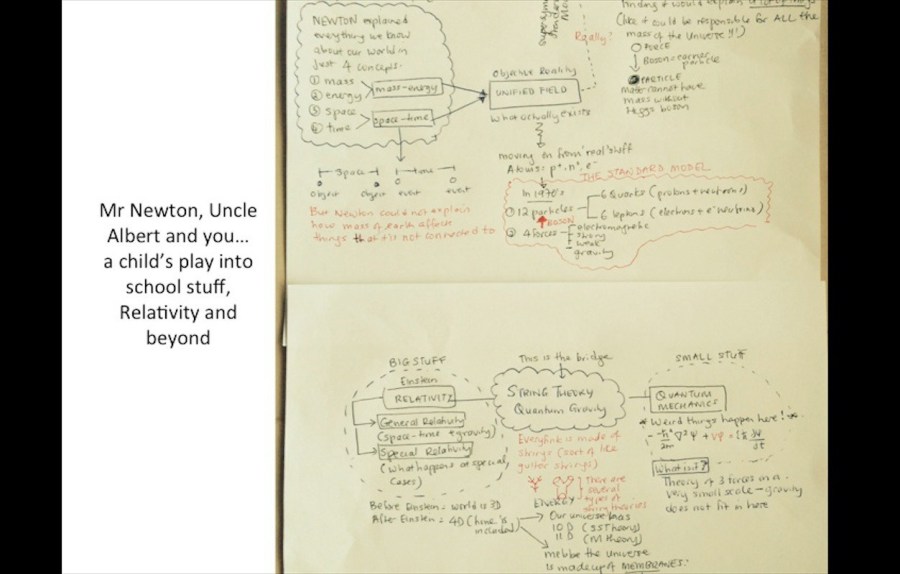
No, we teach our child to learn. Relativity, Quantum Theory and other big-ticket topics that fire the imagination are merely tools for learning, and not the actual Holy Grail. These subjects teach a child that the world is not known, much as we like to think it is, and orders are rapidly changing.  This is why Ptolemy is proven wrong, whilst Einstein’s legacies are work in progress. Learning how to think is expansionist and cannot be converted from textbook learning.  It is from a different branch all together.

For background, Claudius Ptolemy was an influential mathematician, astronomer, astrologer, geographer and poet. Ptolemy was famous for a number of discoveries, out of which the most famous was a theory that expounded that the earth was the centre of the universe (though some might argue that Ptolemic system holds true for some isolated cases). We now know that the earth is not at the centre of the universe, and nor is the universe the centre of other universes. There is no centre, though no one knows for sure, not even the ‘experts’ with their space-age, multi-billion dollar toys. And this is what I answered to a mother today who suggested that I seek experts to help my daughter with her maths: there is no expert, and the best teacher for a 15 year old child is her parents. Maths knowledge – or any non-contextual knowledge for that matter – will not make her a better person, or a happier one, or a successful one, if your definition of success is a balanced, productive adult with a fulfilling personal life.

I was once asked, when I was giving a talk at the Science Museum London, what I thought about Einstein’s Relativity equations.  Thinking on my feet, I responded immediately, “They kind of work, because Einstein left gaps in it for things that he did not yet know.” I was terrified of being misquoted afterwards, as it was a high profile event and I shared the stage with Professor Michael Rowan-Robinson and A.S. Byatt. To compound my worries over my unscripted grandiose statement, the ultimate head of my department at that time was Professor Christopher Llewellyn Smith, who was the Director General of CERN, the European multi-billion pound research facility in Geneva. The dressing down never came (maybe I was correct, but who knows), and a few weeks later, I won the Department of Trade & Industry’s SMART Award.

I don’t use any of it. Except maybe to win arguments with my child.

But this is the important lesson I learned from Einstein: as time passes, we will continue to grow and gain a deeper understanding of things, and we will see things differently. We must allow for the empty spaces in the present.

As my child succinctly summarises, “Oh, the textbooks are not always right then.” And neither are parents.

Real knowledge has to be discovered, either in the real world or within the unplumbed depths of your mind. It does not come spoon-fed to you, either in books or the Internet. And that is what we are teaching our child: to think critically, to question relevantly, to search effectively, to create workable frameworks, and most of all, to find joy in the living and meaning in the caring.

I dedicate this article to my dear friend Richard Boyle, who understands what I am trying to teach my child, keeps me inspired and gives me much joy.

Emotional Health, Not Academic Obsession

When I wrote my book, Barefoot in the City, I put down the heart of my ethos and philosophy for raising children. With the exception of my eldest child, my four children were schooled in the British system, both at home in the UK and at international schools in Asia. For me, with the benefit of hindsight, the greatest thing about the British education system is that it allows me the flexibility to affect my child’s learning. Its creative syllabus and passionate teachers also play a large role in inspiring my children to be internally motivated, intellectually curious and great orators.

However, though I am appreciative of the British education system and what it has done for my children, in truth, I am a passionate advocate of the Waldorf education philosophy. Simply because I believe in the Dalai Lama’s saying that ‘the planet does not need more successful people’.

“The planet does not need more ‘successful people’. The planet desperately needs more peacemakers, healers, restorers, storytellers and lovers of all kinds. It needs people to live well in their places. It needs people with moral courage willing to join the struggle to make the world habitable and humane and these qualities have little to do with success as our culture is the set.” -Dalai Lama

There are some really lovely parents in Asia, not only the fabled Tiger Mums. Haslinda Halim from Malaysia is one, and she gives me hope.

Yesterday, Haslinda simplified our shared philosophy in a nutshell:

1. 0-7yo focus on hands and good things
2. 7-14yo focus on heart and beautiful things
3. 14-21yo focus on the head and the truth


1. 0-7yo focus on hands and good things

It’s no secret: my children are late readers. I could never understand the mad rush to get children reading way before they are ready to. My belief is that the focus during the early years should be spent entirely on teaching children about their relationship to the world they live in. This relationship can only be learned by doing and exploring and discovering, not from books or by instructions. The 24 hours in a day is barely enough, given that the world is such a big, magical place.

Young children need to learn that they have eyes, ears, nose and skin that enable them to interact with their world, cultivating an early system of emotional intelligence. Young children need to learn to use their hands too, because it teaches them empowerment. Our little people all could cook, garden, knit, build things. By doing all these, a child feels rooted and develops a clear sense of self, which will help him relate to his world and others around him.

If you feed a child with good things, she will radiate good things. Georgina refuses to read as a child. Rather than getting angry with her and forcing her to read, her father patiently spent years reading to her every night. He read pony stories, he read fairy stories and he read teenage stories. It became their special time at the end of each day, something to look forward to, cuddling up together with a book, these bedtime stories were magical.

English remains her weakest subject because she does not have an affinity for the written word. But she brings such a breadth and depth of insight to the language. For example, she asked us to correlate between the words parent, participant and participle.

The other beneficial thing to emerge from the ‘hands and good things’ phase is that all my children are very confident physically. They have spent much of their childhood naked outdoors, climbing in the Alps, in sunny meadows somewhere, scrambling over rock pools, jumping on cowpats and playing a million outdoor games. I simply love Georgina’s physicality, the way she charges at the world with her arms outstretched, eager to meet the new challenges each day, secure in the knowledge that she is empowered, in control and happy with her place in the world. That’s what her first seven years of life had given her.
2. 7-14yo focus on heart and beautiful things

I take ‘giftedness’ in children with a large pinch of salt, because my fundamental belief is that all children are gifted. And gifted or not gifted, children still have to develop the same skillset to function happily in this world, to be contributing adults that the Dalai Lama and our inner wisdom speak of.

Two of my five children are mathematically gifted, but they are schooled alongside ‘lesser children’ (I say that with tongue-in-cheek). I nurture their gift, but I choose to nurture the hearts more, because a good heart is the platform for the gift to sit on and serve. It is easy to cosset Georgina and buy into the belief that I have a young Einstein, but instead, she learned mathematics from another enthusiastic mathematician Gary Macaulay, her father’s buddy, in pubs, making tetrahexaflaxagon models out of beer mats and loose sheets of paper (try it). No, she does not get special treatment because she can ‘see’ maths.

Georgina does not need our help when it comes to schoolwork, but we subversively entwined ourselves in history, English, maths, business studies, science and the other subjects that she studies. The reason is not to help her achieve better grades – because she is already top of the class for many subjects – but to weave heart and values into those subjects. After all, we must never lose sight of the fact that the real value of learning those subjects is simply as a guide to help us understand ourselves and our world more, and to learn how we can make the world a better place. So onwards with the First World War, company valuation models, chambers of the heart and tetrahexaflaxagons. They are beautiful, if they are learned with beauty in the heart rather than blinkered goal of getting 100%.
3. 14-21yo focus on the head and the truth

Entering this phase, Georgina is beginning to ask us difficult questions, which some parents would consider ‘rude’. (That is the beloved trick of Asian parents, to chide a child for being rude to get out of answering difficult questions or facing uncomfortable subjects). But the fact is, Georgina just wants to delve into ‘the truth’, and at 14, her tentacles are fully extended to gather information to aid her cognition of ‘the truth’ and find her own version of it.

But as we know, truth is subjective.

For example, I believe that primary healthcare should never be in private hands. I also believe that the UK has a weak government at the moment. I believe in many things, which are not necessarily right. I would never influence a child to vote for the same political party as me. Thus it takes a whole village to raise a child, to give her a balanced view of the world to enable her to find her own place in it. We are grateful for the villagers who help us to raise our child. In this month alone, during our long car drive to school, we discussed the possibility that vegetarianism could be unkind to some animals (loss of habitat, etc), the existence of other intelligence in the Universe, creative accounting practices and UK job conditions.

Without exception, my children are all great at provoking, challenging and defending viewpoints on a wide breadth of subjects, and have never been hesitant in voicing their opinions or engaging people in debate from our road-less-travelled parenting ethos.

I have raised an investment banker, a Naval officer, an interior designer and a property developer. The biggest triumph for their father and I, however, is not that we have raised successful professionals; rather, we are imbued with deep joy at the loveliness of our children in the way they care for their grandparents, the manner in which they love each other, their inherent happiness and their commitment to the values that we have brought them up with. I am glad there is now an academic study by London School of Economics’ Centre for Economic Performance to give credence to my deep personal beliefs that a child’s emotional health is far more important to their satisfaction levels as an adult than other factors. You can read more on Professor Lord Richard Layard’s work here: http://cep.lse.ac.uk/_new/research/wellbeing/